July 22nd
Hello South Africa!


We arrived last night, rented a car, drove to an apartment that had heat. It is inside an enclosure that has a wall with glass on top of it and on the gate it is written Armed Response. All the buildings have the same gated system, with inter phone, on which the right of admission is reserved. All these things make me feel like I am not safe outside. And I am anxious, because of what I read in Mandela’s book “Long Road to Freedom” and of my experience of social unrest, when the communist rule in Romania was overthrown. Different arguments arise in my mind “The things happened almost twenty years ago, they had all the time to calm down!” “Not when you grow up in apartheid, in a segregated society!” “You are being paranoid and judging. Just wait and see.”

This morning we left for Cradle of Humankind, a World Heritage Monument, drove around, we lost our way. There it was interesting, an exhibition about our scientific ancestors with life size replicas, telling us how they hunted, what tools and so on.

In this area they found many specimens of Australopithecus Africanus (there are other kinds) and some of them are still excavating. It was different from other museums because of the focus on how we evolved, presenting along the way our mistakes too, in the past and in the present.(the extermination of different species, garbage that takes ages to reintegrate in nature, the high consume of water). And it asked questions.


We saw some fossils and before leaving we saw Nelson Mandela’s handprints and took turns trying them.

In this area they found many specimens of Australopithecus Africanus (there are other kinds) and some of them are still excavating. It was different from other museums because of the focus on how we evolved, presenting along the way our mistakes too, in the past and in the present.(the extermination of different species, garbage that takes ages to reintegrate in nature, the high consume of water). And it asked questions.


We saw some fossils and before leaving we saw Nelson Mandela’s handprints and took turns trying them.
We drove toward Kruger on very good highways. From time to time I saw signs: Hijack Area, do not stop. The vegetation is burned, the ground is black and the air has smoke. Why? People walk on the side of the highway, or cross it. There are holes in the fence along the highway, cars stop to take or drop off people, they hitchhike. It is like they didn’t get used to the highway system.


We stop for groceries.
July 23-28
Kruger Park again. It feels so good to be inside, to feel safe.

We move around different camps, looking at their small museums about animals, drive for hours, looking at the animals.
We bought a book with maps and it has pictures of the many animals and birds (so many!). We’re ticking them as we see them (the one that spotted it has the honor).


One day we saw lions, two in one area and four in another. They already had their meal, sitting with their paws in the air and just looking mildly interested at the impalas trying to approach the waterhole.

On a different day we took a secondary road but it was blocked by a buffalo herd that was crossing the street. The males confronted us, the females postured themselves in front of their calves then, seeing that we are not moving, continued to graze. We were running late and realized that we risk having the gates of the camp closed on us waiting for the buffaloes, so we turn back. A bull giraffe is teaching a little one to fight in the middle of the road. He charges us when we try to approach. Eventually we honk, and that scares them away (it is against the rules). In our rush we almost pass a leopard. We follow him for 12 minutes, until we can’t see him anymore.

A mile before the camp we see a white rhinoceros. The next day we won’t see any major animal, just impalas, zebras, elephants and birds. Talking about birds, there are people here who have huge lenses, as big as a violin (I think they need a special luggage for it). They make me feel inadequate. But that small voice in my head answers that they are totally unprepared for a trip around the world, so there!

We move around different camps, looking at their small museums about animals, drive for hours, looking at the animals.
 |
| The differences between the white (on the right) and the black (on the left) rhino. Their horns could reach 1.5 and 1.3 m at the end of their lifespan. |
We bought a book with maps and it has pictures of the many animals and birds (so many!). We’re ticking them as we see them (the one that spotted it has the honor).

 |
| Klipspringer, a very small antelope, it stands on the tip of its toes. |
 |
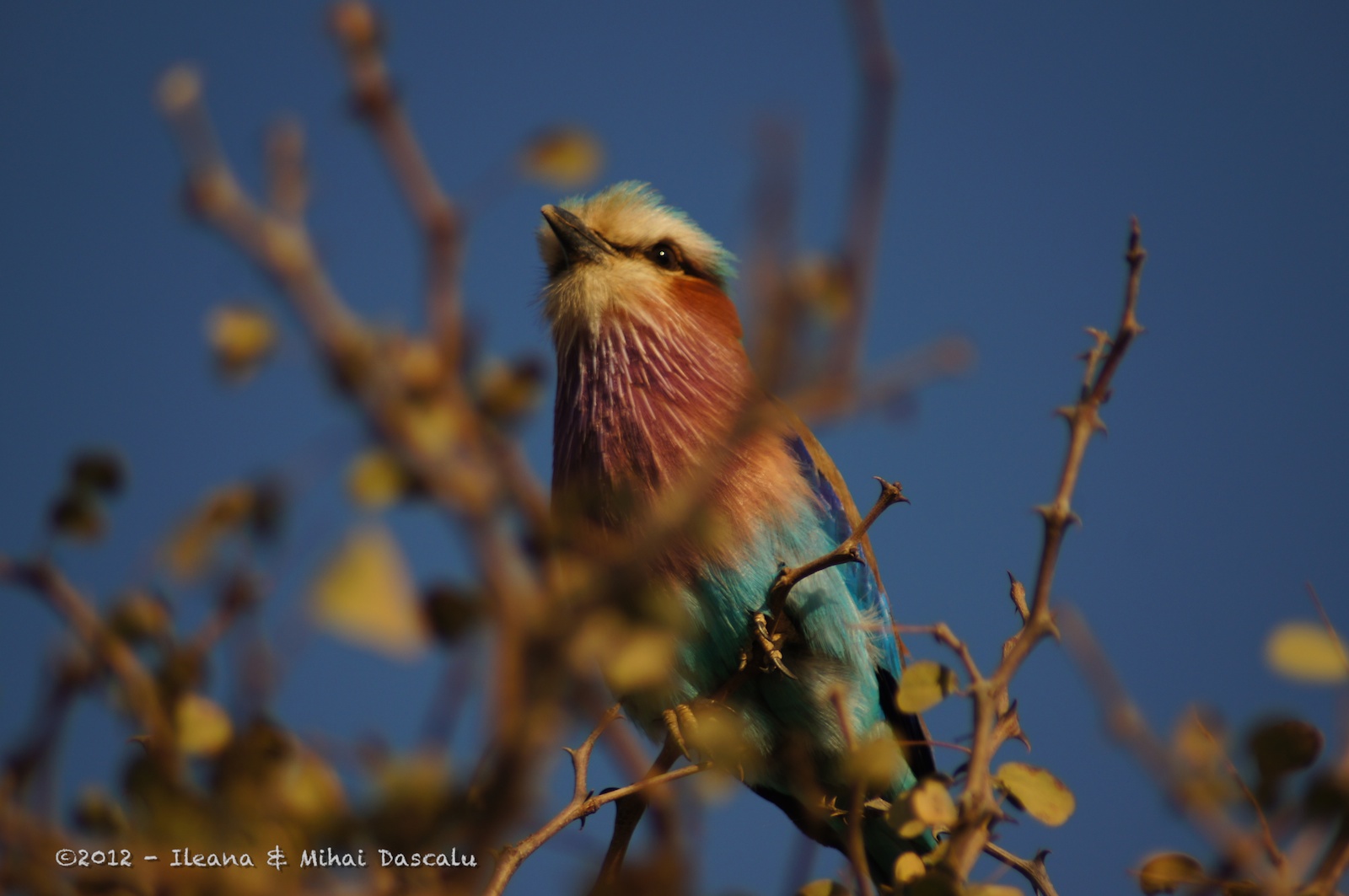
| Lilac breasted roller |
 |
| The cleaning crew |
 |
| I don't remember it's name |

One day we saw lions, two in one area and four in another. They already had their meal, sitting with their paws in the air and just looking mildly interested at the impalas trying to approach the waterhole.

 |
| The impala is on the right and the lionesses on the left, watching each other over the waterhole. |
On a different day we took a secondary road but it was blocked by a buffalo herd that was crossing the street. The males confronted us, the females postured themselves in front of their calves then, seeing that we are not moving, continued to graze. We were running late and realized that we risk having the gates of the camp closed on us waiting for the buffaloes, so we turn back. A bull giraffe is teaching a little one to fight in the middle of the road. He charges us when we try to approach. Eventually we honk, and that scares them away (it is against the rules). In our rush we almost pass a leopard. We follow him for 12 minutes, until we can’t see him anymore.

A mile before the camp we see a white rhinoceros. The next day we won’t see any major animal, just impalas, zebras, elephants and birds. Talking about birds, there are people here who have huge lenses, as big as a violin (I think they need a special luggage for it). They make me feel inadequate. But that small voice in my head answers that they are totally unprepared for a trip around the world, so there!
 |
| Fish eagles, calling right before flying. |
On the last day we started a line! Every time we saw a car stopped we would slow down to see what they are looking at. If the animal stayed long enough and it was of a major interest (like lion, leopard) we would find a spot to have a better look. And others would do the same thing, making a jam. This time we were the first to spot a cheetah and gazed at it for 5 minutes all by ourselves.
Then another car came, and another one, then a whole morning tour bus, but we had the best view! The cheetah lied on one side and slept with his head up, yawning from time to time. He ignored us, then he decided to lye down and we couldn’t see it from the grass. We left, visited something else, and after an hour we returned. He was still there, and the cars, but we really had to leave.
 |
| My favorite feline, cheetah. |
Then another car came, and another one, then a whole morning tour bus, but we had the best view! The cheetah lied on one side and slept with his head up, yawning from time to time. He ignored us, then he decided to lye down and we couldn’t see it from the grass. We left, visited something else, and after an hour we returned. He was still there, and the cars, but we really had to leave.
At the backpackers hotel where we’re sleeping, Alicia speaks Afrikaans, a language derived from Old Dutch and she taught me how to say Hello— Goee dag (hue-eh dah), Thank you—Dankie (done-key) and Good bye— Totsiens (taught-tsins).
We finally finish the malaria prevention! For more then 40 days we took doxycycline two times a day.
July 29- Aug 2
We drive through villages and towns with a normal aspect, no walls with glass on them. The most prominent building is the Funeral Home. We pass plantations of bananas, bagged already in blue sacks (to protect them from baboons).

Also evergreens and eucalyptus, for cutting. The plots alternate new plantation, growing, waiting to be cut, already cut.


Also evergreens and eucalyptus, for cutting. The plots alternate new plantation, growing, waiting to be cut, already cut.

We’re in St. Lucia, a small town on the East Coast. We rent an apartment with three bedrooms and watch the Olympic Games. We cheer for every Romanian or US contestant, but in the same time we are happy for the Australian victory, or for the South African one or for every country that we visited. We spend some time catching up with the blog, and in general with pictures, back-up. The girls are working for our trip presentation at the camp.


We visit the wetlands and see some hippopotamuses laying in the sand, the sea rolling waves behind them.

We go to Cape Vidal where we find a community of people, fishing. This is not my sport and I am trying to understand it. There are at least a fifty men, 30 boys and two women on a windy and chilly shore, totally absorbed by their activity. They must like it!


We go to Cape Vidal where we find a community of people, fishing. This is not my sport and I am trying to understand it. There are at least a fifty men, 30 boys and two women on a windy and chilly shore, totally absorbed by their activity. They must like it!

Aug 3rd
Shakaland was the set where they filmed in 1984 a series about Shaka, one of the great Zulu kings. The movie had a great impact and they transformed the place in a touristic attraction. We watch a very shortened version of the movie, only 12 minutes (instead of 9 hours) in which we found out that he was not welcomed in his father’s house, joined a rival tribe, advanced in rank and at the death of his father he went to claim the throne. He invented a new weapon, a cross between a short spear and a sword, very good at slain people! He trained his people to fight as a group, reinventing Roman methods. He even defeated the British army, he was that good (they got him eventually, his weapon was no match against bullets).
We got to move around, guided by Muso. He asked us where are we coming from. Romania. What is the main language there? Romanian. I could laugh at his question, but in South Africa there are 11 official languages. He explained many things about customs of old times, how they are trying to keep their culture alive through the new ones and I wonder what chances they have.
 |
| Musa explaining the compound. |
To marry, a man has to pay 11 cows (22 if she is a princess, 16 if she’s the daughter of the chief, 8 if she was already married once and had a child). He sends a love letter, made of beads.

If she accepts him, she will give him a white bead necklace. If she doesn’t, she sends back a beaded letter with black in it. He can have more wives if he chooses so, but he has to give them their own house and sometimes their own kitchen. He doesn’t live with them, but in his hut. He visits his wives. The children start helping around since they start walking and when they are 16 years old, they move in yet another hut, with older brothers or sisters (who leave the compound only if they get married). In the middle of the compound there is the cattle ground with a lone pole (for milking the cows) and a dung hidden underground cellar, for food storage (so the enemies could not poison the food). The wife has to wear a red circular hat all the time, she can’t take it of when she sleeps, so she rests her head on a wooden little bench (these hard things to sleep on I found them at the Egyptians, Chinese... I wonder if it’s healthier or just another method of insuring short sleep and long working hours?) She also has to wear a pleated skirt, made from cow leather, that is heavy, so she can’t run away. Her life is revolving around her house. She can’t go to fetch water from the river, with that hat on, so she sends her daughter.
She cooks, washes, sews, makes pots out of clay, gives birth to children and takes care of them. The man makes shields out of hides, learns to fight and to hunt.


If she accepts him, she will give him a white bead necklace. If she doesn’t, she sends back a beaded letter with black in it. He can have more wives if he chooses so, but he has to give them their own house and sometimes their own kitchen. He doesn’t live with them, but in his hut. He visits his wives. The children start helping around since they start walking and when they are 16 years old, they move in yet another hut, with older brothers or sisters (who leave the compound only if they get married). In the middle of the compound there is the cattle ground with a lone pole (for milking the cows) and a dung hidden underground cellar, for food storage (so the enemies could not poison the food). The wife has to wear a red circular hat all the time, she can’t take it of when she sleeps, so she rests her head on a wooden little bench (these hard things to sleep on I found them at the Egyptians, Chinese... I wonder if it’s healthier or just another method of insuring short sleep and long working hours?) She also has to wear a pleated skirt, made from cow leather, that is heavy, so she can’t run away. Her life is revolving around her house. She can’t go to fetch water from the river, with that hat on, so she sends her daughter.
 |
| The water jug has that kind of mouth to keep the water in. |
She cooks, washes, sews, makes pots out of clay, gives birth to children and takes care of them. The man makes shields out of hides, learns to fight and to hunt.

We move from one station to another, and I count 20 people who bring this village to life, here making a pot, there making a shield. We are offered in a gourd local beer, a fermented sorghum and maize drink. It had a brownish purplish color, a pungent smell, and a slightly alcoholic and sour taste.

We were given a break to buy some of the beaded jewelry, but I chose to talk with Musa and ask him how to say Hello—Sawubona (sah-woo-bone-ah). The Thank you is different if it is just one person Ngiyabonga (hard sound ge-ah-bone-gah) or many Siyabonga (see-ah-bone-gah). Saying Good bye depends on if your leaving you say: “Stay well” Salakahle (sah-lah-kah-leh) or if someone else is leaving you say: “Go well” Hambakahle (hum-bah-kah-leh).
 |
| After washing the sieve (that brown braided thing) with water, the beer is sieved and then served from the right bowl. |

We were given a break to buy some of the beaded jewelry, but I chose to talk with Musa and ask him how to say Hello—Sawubona (sah-woo-bone-ah). The Thank you is different if it is just one person Ngiyabonga (hard sound ge-ah-bone-gah) or many Siyabonga (see-ah-bone-gah). Saying Good bye depends on if your leaving you say: “Stay well” Salakahle (sah-lah-kah-leh) or if someone else is leaving you say: “Go well” Hambakahle (hum-bah-kah-leh).
After the break we went into the Grandfather’s House, (which is the most important house in the compound, because they gather there for the worshiping of their ancestors or for meetings) to see some dancing. Musa made a sign showing us to follow the warriors who came singing and entered the hut, but we told him “Men first” sign that we payed attention to his explanations. He laughed and entered first, followed by all the men in our party, who set themselves on the right side, and after that we, the women, entered and sat ourselves on the left. The king occupied his throne, and three wives sat around him, some men went at the higher level, where they started beating huge drums, while others gathered and danced.

The dance followed the drums, with vigorous movements of the body, and they all knew which way to turn and especially when, but what remained with me was a powerful pawing of the air with their right foot. It seemed very important to stomp that foot from as high as possible and after three of these they would fall backwards on all four, like they have stumbled on something more powerful and frightening. The women danced too, in the same style, and all sang and clapped and were full of energy. I didn’t have time to ask if there was a ranking in the way they were wearing the skins or in the decoration of their body. After that it was a collection and the tour ended with us at the dinner place.


The dance followed the drums, with vigorous movements of the body, and they all knew which way to turn and especially when, but what remained with me was a powerful pawing of the air with their right foot. It seemed very important to stomp that foot from as high as possible and after three of these they would fall backwards on all four, like they have stumbled on something more powerful and frightening. The women danced too, in the same style, and all sang and clapped and were full of energy. I didn’t have time to ask if there was a ranking in the way they were wearing the skins or in the decoration of their body. After that it was a collection and the tour ended with us at the dinner place.

It was a buffet style with cold meat and salad for appetizers, and traditional hot food. While I was serving myself one spoon from each, the woman told me in a low voice: “Did you see that man? He is the manager of this place. He asked where is mama Dina, because he didn’t see her, and she is gone and cold for six months now!” I presume she was unhappy with this manager who seemed to know his people, but didn’t work close enough with them. The food was good, some of them we have them in Romania, but with different spices. And for dessert they had crumbled apple pie with warm custard and fresh whipped cream! Mmmmm.
For the next three nights we’ll all sleep in the same room at the Backpackers and we have the possibility of self catering. We also have an electric heater, it is cold in the night time, as we are in the mountains.