Showing posts with label South Africa. Show all posts

Friday, August 17, 2012

Journal of a Nomad through Vasteland (4)


August 11  

We packed our bags and went to an Ostrich Farm to have a tour. We had to wait for 11 o’clock, and perused the shop. They had simple eggs, decorated, painted, sculpted, transformed in lamp shades. Beside this, feathered dusters, feathered snakes and all sorts of things made from the ostrich skin (it looks geometrically bumpy). Needless to say everything was so expensive. On the grounds there was an old round school that housed the names of people who donated for the new school. We found three Romanians and one guy who was from the country Texas (sic!).

What we learned about ostrich farms: they started in 1800’s because the fashion of that time required fluffy feathers. At some point they sold one ostrich feather for its weight in gold. The “feather barons” built themselves beautiful houses, including a pool for 15 people, but that was never used (it would require the water supply for a year). When the fashion changed there was a slum, but they changed too—now they are growing them for meat. Ostriches are not bright, they have only 40 grams of brain, so any enriching program failed. They go for their fellows’ backs, pecking their feathers off. 

The highlight of the visit was riding ostriches (same as Moco in "Two Years of Vacation" by Jules Verne). Mihai and myself got to mount one (we’re overweight by ostrich-riding rules). The bird had its chest in a V-stall, and a man was holding it in there from behind. The back was wide, and warm. I petted its neck, it had a warm snake feeling, it was awesome. The children had a blast! It was very close to rain, and there were other people with children, but for some reason the guide took a like to us and invited our children first, before rain started. They were supposed to climb on the bird’s back, hold onto the wings, cross their ankles at the front. A guy would take off the bag that covered the ostrich’s head and start yelling, and another one would hold my child from behind so s/he would not fall. The bird would start running around and all the others, slowing themselves down. Ileana was laughing, happy, no constraints. Ioan too. Maria was still waiting for the exciting part to start, she felt comfortable as on a horse.


Rain pelting on us we drove South, toward Garden Route. It is a scenic drive, between rolling hills, cliffs and ocean. This is an area were one is supposed to take a vacation, have a stroll here, eat there and so on. We didn’t have the time. We stopped in Knysna, that looked so much like our home town. We were laughing that we travel the world, only to discover that we already live in the most beautiful part of it!

We're crossing small mountains to get to the sea.

August 12

Today is Mihai’s birthday! Today we did what he wanted. Drove. First in the area. 


When he figured out that what they had to offer required time, he moved on. We drove. It was a one lane road, with a wide shoulder, on which people drove, to let us pass. As a thank you, we learned to blink a few times the emergency lights.

We stopped in Mossel Bay where the first Europeans anchored their vessels. The name of the courageous captain was Bartholomeu Diaz and the year was 1488. Beside artifacts and history stuff, they had a full size replica of the caravel (designed after incomplete archival documents). It was built in 1987 and it took 3 month from Lisbon, Portugal to here (instead of 6, like the original voyage).

Each peg on the circle marks half an hour and the compass point on which the ship run. The horizontal pegs mark the speed. 

 It seemed really small from the outside, but when we stepped on it, it was big. It had a rudder till, the wheel was a later improvement.


They also had an exhibition “Separate is not equal” the struggle against segregated schooling system in America (I love it, how outside people, including myself, refer to USA as America, like Canada and Mexico are not part of the continent). The children were glued to the panels, read every word of them and wouldn’t pay attention to the other things. Ioan told me that he was interested; he read part of these in his history book and he wanted to know more. Watching short movies about Ku Klux Klan or politicians promising that they will not accept black people in their white schools made me sick. How does my skin color make me better than another fellow? I remember reading this, sculpted in rock, in a park in Sydney: “No man is better than me. I am better than no man.”


We went to visit the shell museum that was right there. It would have been interesting if I could have torn myself from the TV screen, where they where showing the last minutes of the marathon race. The guy kept turning back, to see if they were catching up to him. I would have liked to finish in the stadium, keeping up tradition and also, there is a different cheer sound in a huge bowl than in an open street. After all, the guy ran for 42 km and was ending an olympiad.

Again Mihai drove, racing against time to reach the most southern point of Africa. Rolling hills: yellow with mustard flowers, green with alfalfa, dark brown with fresh tiled soil. I couldn’t take a picture with my camera, but I have a memory drawer for the image. It superimposes with the South African flag.


And we arrived. Cape Agulhas, the Needles. People were taking pictures with the setting sun, with the waves, with the sign. Theoretically this is the point where two oceans meet, but for sure is a moving point somewhere between this one and the Cape of Good Hope, depending on the season and the currents. There we would see the water coming from two sides. Here is just a froth over seething rocks.

It is called Cape Agulhas because the needle of the compass pointed North.

We sang Mihai "Happy Birthday" and gave him the gift: a twenty billion-dollar bill. A Zimbabwean one. It has no value now, just for us, to say that we are billionaires.

I asked him if he liked his birthday, after all, he drove almost all day long, for just a few minutes on a windy shore. YES, he liked it very much, seeing so many things and feeling the spring in the air.

August 13

We started our day by visiting the light house, climbed to the top of it, took lots of pictures and then back to the car.


Typical Dutch house.

We stopped in Hermanus, a quaint city on the shore of the Atlantic Ocean, with parks on the cliffs from where we could watch whales. I think sperm whales. It doesn’t matter. There were several water spouts from time to time, the whales bobbing with the waves, turning themselves with one flipper up. We would watch them through the binoculars and our imagination would fill in what happened underwater. 

A little bit to the left of the middle of the picture there is a black and white dot. That's the flipper of a whale.

Rock dassies, warming themselves on the rocks.

Eventually we reached Cape Town, with Table Mountain against a golden red sky. We got lost on the highway, and I had to be, again, the copilot, looking on the iPad’s GPS, telling Mihai which way to go (I really don’t like it). After the highway, we arrived on said street, only to find out that is very steep and has tall speed bumps that scratch the car’s belly. We found the house and the keeper took an hour to explain things that didn’t need to be explained. Aaargh.


August 14-17

We wanted to do so many things: visit Robben Island (where Nelson Mandela was imprisoned), go on top of Table Mountain, see the city, visit some museums. In the beginning we couldn’t find tickets. Then when we found them, the weather had different ideas, with winds of gale force, that canceled everything. Even the coast road was closed.

View of Cape Town from the level of the funicular.

Table Mountain covered by clouds.

Table Mountain on a windy day.

But we could visit the Cape of Good Hope.

And in Afrikaans: Kaap die Goeie Hoop, die mees suidvestelike punt van die Vasteland van Africa.
I liked the sound of Vasteland. South Africa is huge indeed.

 I am happy that I touched this point, all those Jules Verne and other adventures books that I read as a child. The park in itself was frustrating: we would see a beautiful vista and wanted to stop, but there was no shoulder and no spot to park. Where they had the parking areas, there was nothing to see. And we met a pack of baboons and a youngster climbed on the car and pulled at the antenna. I don’t like monkeys anymore!


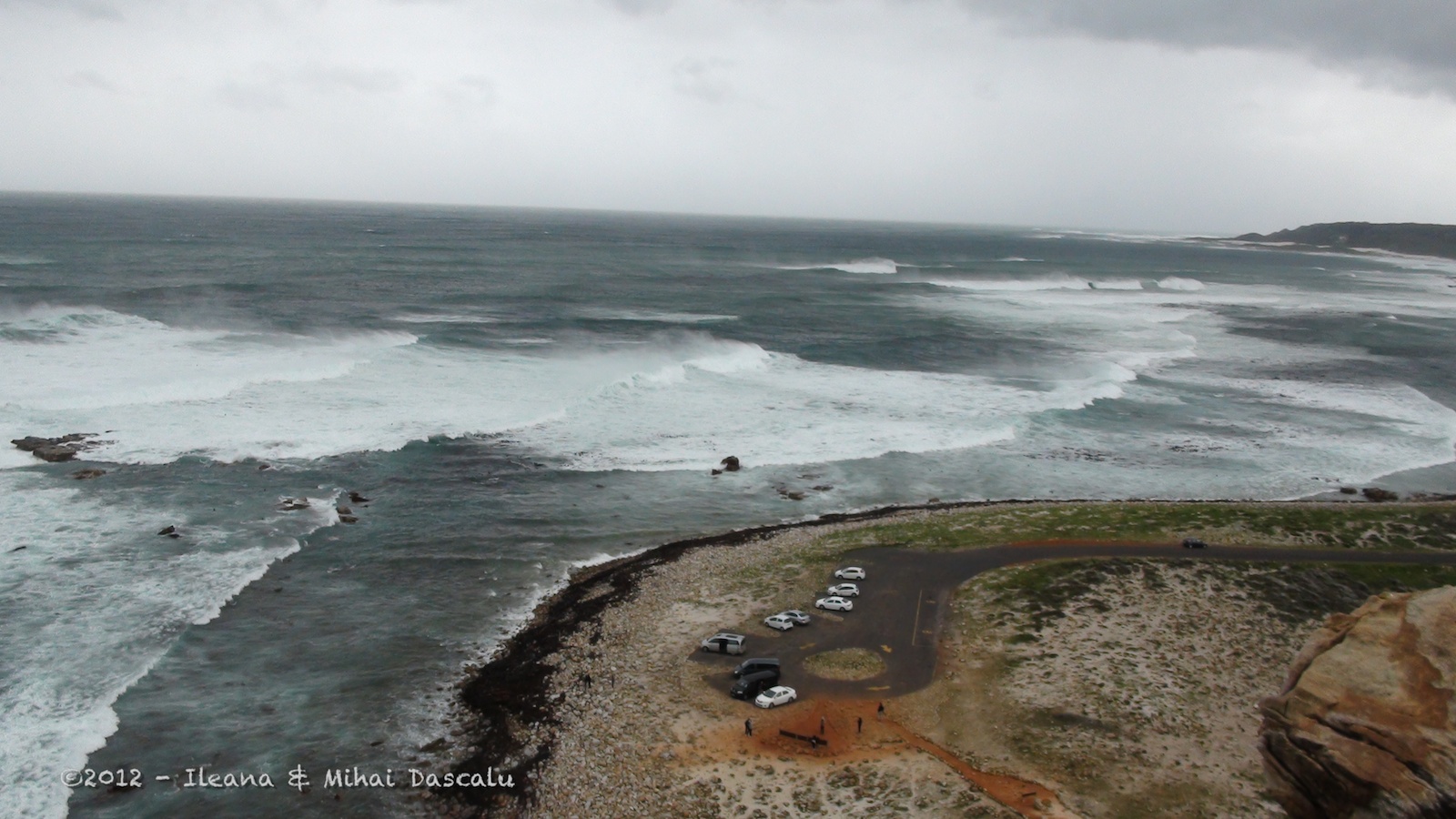
The wind is blowing so forcefully that it takes the foam backwards.

The rest of the time we rested in the apartment. The girls worked so hard to finish the movie. They are leaving for 10 days at the camp in US where they would present “Noi6 Around the World; Ten months in” and I am proud to say that they did a very good job. I hope they have a good reception. We watched several times in a row. About their leaving by themselves I am and I am not concerned. They know all they need to know, we’re just a phone call away, and I am sure they can manage everything. It’s just that they are not going to be with me.

One afternoon we went for a haircut and we talked with the hairdressers, one of Indian descent, one I wasn’t sure, she could have been simply white. In the beginning they were very quiet, not saying a thing. Curios! Then one of them asked Ioan how old he is, and she said she has a son of the same age, twelve. We started talking about school, how now is integrated, how they mingle black, white, colored (of Indian, Asian or other descent), visit each other’s houses, work on projects together. They were proud of their new found freedom. I asked about holidays, I do this in every country. Six weeks in the winter (summer for us), two over Christmas, two more for Easter. I hit the can of worms when I asked what about other religions. It is unfair to have vacations Christian related. What about Devali, the festival of lights for Hindu populations, or Chinese New Year, celebrated by many asians, regardless of being Chinese or not. And even Easter is not the same day, for Jews, Catholics and Orthodox Christians. As a government, what do you do? Do you give all of them day off? That could bring the country to poverty. Do you give day off only to the people who celebrate that day? In India they do that, at least in some parts of the country. That would bring mayhem, which institution function in which days, or with how many people. It seems simpler to take away all these religious holidays, and give back people invented ones, that have resonance with the people who live in that country, like Columbus’ Day. But I think this would be sad, it doesn’t deal with the diversity of that country and brings a false sameness. I am not a governor and no one asked my opinion, but I need to do something about that, to make people aware that we are the same, only from different backgrounds.

It’s time to leave Africa. It doesn’t feel the same as in Madagascar, when I was happy to leave, to protect myself from that painful feeling of inability. It feels good to leave it, new horizons, etc, etc. I had a good time, I’ve seen so many things, good ones, beautiful ones. I am not afraid anymore of being white in a black country. I was prejudiced by others’ words and my imagination. I am so glad that we decided to know at least in parts South Africa.


PS. The day we left, the televisions around the world showed footage of unrest in South Africa, miners militating for their rights and then the news that 34 people were shot dead. We didn’t know, people around us were calm, there was no excess of military or police. This is television, its role is to relate the news. Not all of them, just some, the majority bad ones, presented in a truncated way.  A girl in Japan told me she doesn’t want to come in “America” because she is afraid, there is so much violence and gunfighting. She watches her news. If the TV had its way, I wouldn’t leave my house, fearful for my life. 

I don’t watch TV.

South Africa again

There are very few options of getting to Africa from Asia, and aiming for the southern part of the continent there is only one major hub: Johannesburg. Especially when considering our trip to Madagascar, this was our only choice. We wanted to go to Cape Town and I envisioned a loop through Botswana, Zambia and Namibia. It was only shortly before our arrival that Ileana Ruxandra asked: "what are we going to do for one month in Africa?" I explained my ideas and Ileana asked another logical question, "if we are in South Africa why don't we see the country?" I didn't know what to answer, after all what is to see in South Africa?
We belong.


We all know a bit about the miserable history of this country, we all know a bit about the current struggles with violence and we rightly assumed that there still must be a lot of racial tension. Why go there? We already had one week, before our trip to Madagascar, we realized that we could manage and we all agreed to spend the remaining of our time here.

With 50 million people and 1.2 million square kilometers it is the 25th country in the world by population, area and GDP (PPP). For a visitor the uniqueness of it is the mixture of first and third world. Nowhere else could someone find the best infrastructure and services and literally a block down the street, just taking one wrong turn, the misery and insecurity of any African third world country. It has one of the most diverse flora and fauna in the world, and a mixture of climates and geographical formations that can be found nowhere else. There are a couple of must see attractions, but we found that it was a complicated matter to decide on an itinerary. The guidebooks we had were good, but they didn't include all the information I wanted about security and weather. Winter, long distances, too many things to see and do, our limited time and the big unknown of the mood of five people getting exhausted in the tenth month of a long trip. The excitement of the girls returning to America, their requirement for time to work on their major project (a camp presentation about our trip, turned into an awesome documentary of 23 minutes). The anxiety of the parents who would be left behind. I reserved apartments for the first eight nights, going through Kruger again, we had to have everything prearranged. (Not that I had much option, I took what I could find.) But after that, we decided not to plan anything and leave it in the air. Overall, in our 27 days we drove 5250 km, spent the night in 17 different places, we went to several national parks, climbed mountains, got stuck in snow (for just five seconds, but still, this is Africa!), froze at night and melted during some days, walked on several beaches thousands of kilometers apart. We saw countless animals and several people. We visited some museums and one cultural show. We reached both Cape Agulhas, the southernmost point and Cape Of Good Hope, the southwesternmost point of the continent. We rode ostriches. We both spent our 45th birthday in this country and it was memorable. We avoided almost all the cities and we don't regret it. We could have easily stayed twice the time, but we didn't have that choice.

One day we got to Lesotho, part of a couple of daytrips from the Amphitheater Backpackers Hostel, trips sponsored by our friend Ileana and described in detail in another post.

We arrived from Madagascar on a Saturday afternoon and after picking up our car we only had one goal, reaching a hotel for the night. The next day we would get close to the southern part of Kruger, at Hazyview. I realized only then that I should have left some time for visits in Johannesburg and Pretoria, especially the World Heritage Site at the Cradle of Humankind. That was not to be missed, on Sunday morning we were up and ready to go early. We could have passed through the center of Johannesburg, but we got lost and arrived by circling the city. We chose to focus on just one site, the Maropeng Visitor Center. We learned about many different species that preceded the humans. Ileana, our daughter, declared it the second best museum in the world (after Ghibli museum in Tokyo). I am not so sure, but it was fun and instructive.
Maropeng Visitor Center - backview


You guys are back???


Late that night we made it to our destination, a guesthouse in the highveld, near Kruger. We wrote about our first visit here, just a month ago (Links: Mihai's Ileana's & Ioan's). This time around we had twice the time, shorter distances to cover and much lower expectations.
We learned that lions don't follow a certain path or schedule. They were not even hungry when we were around...
 It is hard to describe in just a few words what it means to drive around for countless hours, day after day, looking left and right, through the high grass or in the branches of the surrounding trees, skimming over water surfaces or peeking behind bushes. It was an exhausting activity that, surprisingly, we all enjoyed. Despite being together all the time for the past ten months, there are moments when it feels that we don't have enough time to communicate with each other. Being locked in a car for ten hours a day for a week gave us a different and special kind of closeness.


Photographing a fly attacking a Klipspringer 

And we had time to enjoy birds...


We left Kruger through the most eastern point, Komatiepoort, just 30 minutes from the Mozambican border. We had to take the longer road to our next destination, avoiding Swaziland. It seems to be a fantastic country, but stupidly they require Romanians to obtain a prior visa. Their consulate in Pretoria did not answer my inquiry, shame to them. The aberration of the visa system is one of the most frustrating aspects of international travel. Their loss. We rode fast and beat our expectations so we ended that travel day 650 km away, on the beach of the Indian Ocean, in Santa Lucia. I heard about it as a child, it is famous for the World Heritage Site of iSimangaliso Wetland Park. It is one beautiful touristic village, the hippos still roam on the main street at night. We rested most of the time there. The beautiful beach was too cold and windy for more than a short visit. The drive through the park was for just a few hours on the last afternoon, but it was nice.


Baby rhino in our garden
People generally assume that blacks covered all of Africa some time ago. That is not quite like that, there were not too many people when the Dutch settled the Cape in 1652. But they moved East, and encountered the Xhosa and had some wars. Later the English pushed the former Dutch (now called Africaans) and so on, but what seems to have been the worst part was the growth of the Zulu under their legendary king Shaka. He is regarded as an African Napoleon, maybe appropriately as I have nothing good to say about that French buffoon. As Shaka conquered some surrounding tribes he forced the displacement of many populations and from there we had at least a hundred years of various wars. Even to this day some tribal matters are still unsolved. I have nothing good to say about the English colonialists or the Africaans either, but that's another matter. We decided to go and visit Shakaland and have an "authentic" Zulu experience. There was a successful movie made in the eighties about Shaka and they kept the movie sets to make it a sort of Disneyland. Apparently some people visit South Africa just for this place. There is no other chance around to learn anything about traditional African culture, we had to try. It was almost comical at times, amateurish and absurdly expensive, but we learned a few things, tasted their beer, admired the dancers, enjoyed the traditional "African" food and tried without success to imitate the clicking sounds of the Zulu language.


Shakaland is a couple of hours away from the ocean, in the hilly scrubland that makes most of South Africa. We were already on our way to the mountains. The Drakensbergs range goes through at least 1000 km of South Africa and has some of the highest peaks on the continent. We spent three nights at Amphiteater Backpackers. We spent two days doing a couple of extraordinary trips in the uKhahlamba / Drakensberg Park a World Heritage Site, described in detail in Ileana Ruxandra's post. On August 6 we went for a short trip to Royal Natal National Park (technically considered part of the uKhahlamba / Drakensberg Park) and ended the day at Golden Gate Highland National Park. It was a beautiful celebration of Ileana's birthday, watching the sunset on a high plateau among colorful rocks.


Next morning we saw the first snow in Africa. Just a couple of inches, the roads were covered, the car had problems. We had to drive for 720 km, we altered the itinerary to avoid the mountains, for a few hours we had no idea if we will make it or not. But the sun came out, the temperature got positive, the roads got better. We arrived at Mountain Zebra National park, a smaller, newer park that has a unique species of zebra and several other interesting animals. Unfortunately, the only heating in our bungalow was the fireplace, we burned three loads trying to get the temperature to 10 degrees C.


Our bungalow in Graaff-Reinet
After one day touring the park, like we did in Kruger we left continuing West with an unknown destination. We stopped soon to visit a private "Cat Conservation Center" where Marion taught us about four rare species of African cats. The scheduled one hour tour lasted three, we were exhausted. We decided to stop in Graaff-Reinet, the fourth oldest town of South Africa, the most beautiful, with about 200 national monuments, old colonial buildings. It was right before their busiest weekend of the year, some school sport competitions, we were lucky to find a place that night, but we couldn't stay longer, everything was booked. Just a little tour on their streets and next morning we went nearby, to the Cambedoo National Park and the Valley of Desolation.

We then drove west and south toward Oudtshoorn. We moved fast and at 2 pm I stopped: "we can get to our next hotel in half an hour or in two and a half hours. Which one?" I don't know what the children said, but their mother chose the longer version and she drove away, north through the Mieringspoort pass crossing the Groot Swartberge mountain range. It was a beautiful and short ride, it didn't prepare us for what was to come. We crossed into another part of Karoo, the bush land that makes most of this country, rode through a couple plantations of olive trees and turned south again to cross the same mountains.

Swartberg pass is phenomenal. Scary yes, long, too long, but phenomenal. We drove on some beautiful roads during our trip and I read countless blog posts about the most fantastic rides in the world, but nothing comes close to this, I am surprised that it is not mentioned anywhere. It is an amazing engineering achievement, especially for the end of the 19th century. Pictures cannot capture the whole picture.


Some Jewish guys moved to South Africa in the end of the 19th century and started to grow ostriches. They fueled somehow the Europe fashion of wearing ostrich feathers, and in the process they became very rich. They still make a ton of money from their farms, but visitors now account for a big percentage of their profit. It's all in Oudtshoorn; we spent a night here and the kids rode the huge birds.


With time running out we started to count our days and hours. I wanted to come to South Africa to swim with the great white sharks, it would have been a nice way to spend my birthday. As we were getting closer I realized that I don't really want to do it. The companies that run these tours were accused for increasing the rate of shark attacks on humans, complicated and debatable story, but we decided that we didn't have four hours for this, we could spend $750 on better things, and I wanted something else for my birthday.


We went to Knysna, got a taste of the Garden Route and on my birthday we headed west again. We stopped in Mossel Bay, the place were the first European landed in South Africa. They have a nice museum, named after the explorer, Bartholomeu Diaz. They had a full size replica of the original caravel, but the children got lost in an exhibition about school segregation in America. It was instructive and made parallels with the educational system in South Africa during the apartheid regime. It is surprising to me, how, over and over, people have to fight hard to achieve some rights that the following generations would consider just normal. The opponents usually call themselves conservatives and use some stupid arguments about God. Don't they have any common sense? Don't they have any understanding of history? Why do they make it so complicated, fighting a lost battle? Can stupidity and fear explain their behavior or is it a little bit more complicated than that?


Anyhow, we did our museum tour and left Mossel Bay for one tough drive, 280 km through the hills and mountains to get to the end of the world before sunset. It was a beautiful spring day, yellow flowers covering the hills, mountains in the background. Yes, I will remember my 45th birthday:

Cape Agulhas, really at the end of the world

Five days to go, we will spend the last four nights in Cape Town. On our way there we stopped in Hermanus, a little town by the ocean. From there, if you're lucky you can see whales in the gulfs at certain times of the year. Like now. It is a special feeling to sit on rocks and watch some little forms between the waves, bits and parts of huge whales raising occasionally above the water. I could have stayed there for ages, the pictures cannot show too much but with the binoculars we had a great view.

July and August are the months when someone should not go to Cape Town, the weather is miserable and we knew it. But I took advantage of that, negotiated a great discount, and we stayed in probably the best place we ever had, a huge four star apartment with two levels and all possible amenities. Too nice to leave, rainy outside, we could never get to the two main attractions, the Table Mountain and the Robben Island. The ferry reservations were taken days ahead, but somehow I got a break and found some tickets. Next morning, before getting up we got an email that all the boats were cancelled and we'll get the money back. We did take a couple of rides out, saw some amazing scenery and checked out both the Cape Point and the Cape of Good Hope.


The same cape and the same sign from up the hill

Cape Point a few minutes to the East

Cape Point, overlooking Cape of Good Hope

Birds also come in fives

Down the street from our apartment the famous Cape Mountain

The girls finished their documentary and got ready for America. We had private talks, instructions and hugs. With that, there was no time to get melancholic about leaving Africa behind or concerned about the next destinations. We had ten months on the road already, getting a little tired, less excitable and more selective.

At 35 days, South Africa comes right after India and Australia as the longest stay. The accommodation here was more expensive than our usual, we wanted heat and safety. We had kitchens almost everywhere and we cooked our own food. We hardly ate out, but when we did, we had KFC or McDonalds and that was better and cheaper than expected. Overall, at $5 per person per day, our food expense was 60% of what we had in Madagascar! We all enjoyed the ubiquitous rusks:


In Kruger I saw one of the big trucks I thought we would have to use and I was glad that we had our little Toyota Corola. It was an acceptable option for our one month tour and much better than the pitiful VW Polo we had for the first week. But this truck would make for a nice office:

Maybe next time...