Showing posts with label animals. Show all posts

Friday, November 30, 2012

Kali mera Elada!


Present time (November 30th, 2012):

Duty— You should have written every day!
The writer— I couldn’t, the writing would have been dry, just a bunch of facts, what we did, like a check-off list, no one would have been interested.
The child— Can we play now?
Duty— Now you have to write after almost two months; what would you remember now?
The writer—I’ll write, just leave me alone, don’t carry me to all these new places, give me some time!
The child—I want a roiboos tea!
Duty—We don’t have time! And plus, these new places have to be seen, they are a must, remember that you always wanted to see them!
The writer—OK, let’s see them, but then I won’t write!
The child—And I want to watch a movie!
Duty— You have to write! People are waiting for your blogs!
The writer— Are you kidding me? They live their lives, we’re just entertainment for them, if there is no blog to be read, they just go and find something else!
The child—Look at me! Look at me!
Duty—Then write for us!
The writer—I need peace, and time! Leave me alone, to find my muse, to process those feelings, to make them less personal, to bring a unified image of how it was there, and not the whole material. It was one thing to present Asia, where it was a first contact with a different culture, and another to show Europe. I grew up here, I can tell details, but then I have to explain them, and you don’t give me time!
The child—Ding-dong, ding-dong, ding-dong! Let’s escape!
Duty and the writer—WE CAN’T! WE HAVE TO WRITE THE BLOG!

Two months ago and forward.

Kali mera, Elada! (kah-lee mair-ah) Good morning, Greece!


A three men orchestra plays a Greek tune as we pick up our luggage and file out of airport. I think it’s a nice gesture, like real orchids in Singapore, having live songs in Mykonos; for sure I will remember this airport. Outside, sunshine, not a cloud in the sky, maybe a little bit of wind. Anna, the owner of Evangelia’s Place (named after her mother), shakes my hand, then leans in and kisses me on both my cheeks. She does this with each and one of us, while saying our names. We pile in her car and she starts talking while she gives us a tour of the island: this is the supermarket, next to it there’s a bread shop where they have very good bread, the pharmacy. Houses, all white and covered in bougainville, have rounded corners and a personal little church.

Tiny church with the Greek flag.


In Mykonos first they build the church, and after, the house. The priest follows a schedule to see whose house does the morning or evening service. At the bus stop Anna brakes, looking at the sign that announces the schedule (a blackboard under the shade of a tree), and tells us when we can expect the bus to ride in or out of town.

Street commerce


We talk about the crisis and the strikes. “It’s not that people are not working—they work, and hard, but the system is bad.” Then we arrive at her place, large terra-cotta jars with geraniums or a different type of “hen and chickens”, olive trees and other kinds.


It’s Mom’s birthday and we wanted to be together. Their hotel is literally across the road, with a beautiful view of the sea and an infinite pool. To reach their room we have to climb down and then up a maze of stairs, between palm gardens, and private room yards.


We have a late-lunch/early-dinner meal, watching the sun setting in the sky and eating moussaka and lamb chops with rosemary. Happy birthday Mom and Grandma Tana! On the table there is a vase with flowering basil. It is peaceful and quiet, we’re the only ones in the restaurant, we’re on vacation. When we met with the parents in London, they watched the movie and Mom said “I know what I want for my birthday!” Two weeks is not long enough to work on this kind of project, especially when you have to visit four more capitals, but the girls pulled all the stops and translated the movie in Romanian, recorded a new audio and made it fit on the English cues. The grandparents had a blast, laughing almost continuously and enjoying the commentaries. (In the meantime they started showing it to anyone who manifested a little bit of interest and they haven’t stopped yet! You can see it to if you have 25 minutes  here)


Even if this is vacation time, we can’t pass Delos. It used to be the place to dedicate a temple to one god or another, to bring a prayer and a sacrifice. People used to live here, there are many houses to prove that, but because of a prophecy, the rulers of Athens gave an edict forbidding people to be born or die on the island.


Now, all I can see are just blinding white stones and ruins under the unmerciful sun. We make our way toward Zeus temple at the tippy-top on slippery steps, shined by the peregrines and hordes of tourists. There is no shade, we’re crawling hot and red faced next to a stone wall or a scruffy bush, to find some relief.


Ioan is looking for life forms, but just the lizards are obliging, anything else is hiding from the sun. From the top I look around: sea and other islands. For a moment I try to feel that disappointment, lived by people marauded on an island, but I can’t, I know I have a boat to take me away.


Back on Mykonos we try to retrace our steps and end up going other white and blue streets, squished between stores, bougainvillea and shade canvases. We admire the windmills, the restaurants, with numbered tables and Van Gogh’s chairs (very uncomfortable), the people who chose to sit, drink coffee and watch people passing by. At our place we find out that it was a general strike, and we laugh, Athens is so far away, the struggle on the continent doesn’t impose on the islanders, who earn their life in tourism.


And then... shame! Disgrace! I find a crawling insect on my shirt, that looks very similar with one that I saw in Spain, while I was sewing! It is a louse! Fortunately the internet is working and I can read online what I am suppose to do and what to buy. We all do the treatment, greasing the hair and combing it with that superfine comb, spraying the whole body with the medicine. I am the only one that finds a dead insect body and that is a relief. Then I have to wash and hope that whatever creepy-crawly are on our clothes, they will die in 104 degrees water with detergent (it should be 140 F for washing or 250 F for drying at least half an hour) . I would have expected to pick up a bug in other countries, less developed, but not in old Europe!

The vacation is over, we’re back in our exploring and learning mode. A slow ferry takes us to the island of Syros, the capital of the Cyclades Islands. We arrive on a Sunday afternoon and after the commotion from the ferry, the town seems deserted. The streets are empty, the stores are closed, houses with shuttered windows, an occasional car. From the second story of a house an old lady throws in the street  leftovers from the Sunday’s lunch to the alley cats.

Fearless cats, not flinching in front of a car, eating on marbled street.


This town has names for the streets (really a rare thing) and makes our life easier as we’re walking with our backpacks toward the hotel. We pass a church, that later we find out that it has an icon (religious painting) by El Greco, when he was still only Domenikos Theotokopoulos. We walk up a stepped street, and another, to “Paradise, Rooms to Let”. There is an old man at the reception waiting for us, he doesn’t speak much English, but he understands. He gives us our keys and then, closes the office and disappears.

Agora or the largest flat place in a Greek town.


We take the shortest route to a restaurant where we order the most wonderful meal that we can think of: pita-gyros (peetah). On a flat bread they spread tzatziki (a sauce made from yogurt, garlic, cucumber and sometimes dill), sliced tomatoes, onions, shredded lettuce, french fries and shaves of grilled meat (pork for us), wrapped in a wax paper. As we will find out later, this is the best: pita freshly made, crispy on the outside, hot and chewy on the inside, tzatziki with just a zing of garlic, not too salty, not too runny, plenty of meat, sweet tomatoes ripened on the live vine in the sun. Add to this two sail ships bobbing gracefully with each wave and a setting sun and maybe you will understand why this is and will be the best pita gyros ever.


Later we walk the streets, buy baklavalaki (small baklavas) made with walnuts and saraigli (rounded ones) with pistachios, all drenched in sticky syrup, but still crunchy. Too sweet for Ileana and happily we eat her share.

The many kinds of cake in a sweets shop.


Next morning the town is unrecognizable, so many people, cars wheeze by on the marbled streets, restaurants open where locals and tourist alike drink coffee and nibble a pastry. We board a new ferry, for Santorini this time.


Many like to think that this was the famous Atlantis, but there is no proof. My mind fills in the gaps as we approach the island and I can “see” the huge cone. The island in reality is of a crescent shape with some young islands that hiss steam periodically in the middle. As we enter the submerged cone of the volcano I look at the forbidding cliffs, capped with multicolored houses, terraced for a better view. They used to be all white with blue shutters, a form of resistance and nationalism in a time of Ottoman occupation. The whole island was just a huge flag.


We pass cruise ships, anchored close to the old port, the one with the hundreds stairs and donkey- caravans to haul tourists up, featured in “The Sisterhood of the Traveling Pants” (nowadays they have a small six cabin gondola, but it takes only 36 people at a time, insignificant for a cruise).

Very, very smelly creatures!


We dock in the new port where the hotel’s car awaits. The road zig-zags the cliff and after many hairpin turns we drive on the flat top toward Fira (feerah), the main town. We pass “SeƱor Zorba” a Mexican hotel and restaurant. We smile, there is a little bit of truth, Nikos Kazantzakis Greek hero was brought alive by Anthony Quinn, of Mexican descent. Our hotel has, besides narrow stairs going up and down, sideways and round, a pool and domed rooms, with arched windows and interior shutters. There is even a walled cupboard, like a medicine cabinet. I look closely and find old nails sticking out and irregularities in the masonry. I can’t imagine how old is this room, hundreds of years?

But we don’t have time to muse, we have a sunset to catch. The bus leaves just as we enter the station, so we take a taxi, much better and quicker, to Sunset Point, on the right side of the crescent. Over the horizon a thick haze hides other islands and gives an orange hue to the light. We’re not there yet, the streets are narrow, the tourists are just rambling (they live there in Oia, they can see it as many times as they want), so we're trying to squeeze and run, only to hear “Slow down!” And when we get at the end of the island, we miss it, behind the haze. But the colors are good too, so we linger a little bit more, look at people and go back, along with the others and perusing the art galleries.


Fira is in the background as tiny light dots.


Back in Fira we have a museum to visit. Before erupting (somewhere between 1700 to 1300 BC, different museums post different dates), the volcano was kind enough to give plenty of signs so the majority of people could leave. They took their valuables and left everything else. Just a little part is excavated and exhibited and still is plenty: bird vessels, religious objects, board games, frescoes and the golden ibex, made from separate gold sheets and welded together. The archeological site is scheduled to re-open, but no one knows when. It’s mind-numbing to think of the efforts that go in finding things, extracting them, cleaning, restoring, understanding, preserving and if they are significant enough, exhibiting them in a museum, under 24 hours surveillance.

Different types of bird vessels.

Bird vessel with swallow.

Offering table with dolphins.


Before leaving we buy Santorini pistachio, it’s supposed to be different. We don’t have the “others” to compare, but the shell has a pink rim and the seed is tasty. Also we try homemade wine “vino santo” (vee-noh sahn-toh), strong and sweet, almost like an ice-wine. It is made from the unwatered grapes, like all the plants that grow here, their necessity of water taken from the dew. Then we board our next ferry: Crete awaits us.


Thursday, November 22, 2012

Sinai


Sabaah el her! (sub-ah-L-hair)

"You speak Arabic? Are you Egyptian?" No, I just like to use my limited knowledge and greet people in their language. Ioan and I, both have a darker skin, Mihai is sporting a beard, most of our skin is covered, our men walk in front, we, the feminine side, follow them, yes, we could be Egyptian. We’re not Muslims, but we could be Coptic Christians, or some other religion that doesn’t require  a woman to cover her head. “Tourist” cries from our behavior, but maybe we’re long time emigrated Egyptians, visiting our country. Sometimes I wonder, do we really have this plasticity to fit different countries or is just a way of the locals to brush our ego?

Good morning from the Sinai Peninsula! We’re here to rest, to dive into oblivion, to do nothing, to forget there is a world outside!


We eat, read and sleep. For the first activity we are required to leave the room and seek victuals. In the morning we have a very rich breakfast, with tables laden with trays containing pies, croissants, fruits, cheese and ham, a heaven for a Westerner, and things like hummus, tahini, cheese pastries, beans,  an Egyptian breakfast.

But in the evening we have to brave the streets. We are “aggressed” by vendors, shouting their wares, enticed by a quick look toward their store. They speak Russian, German and English, in this order, and they can barter very well in any language. “Towels for 2 euros!” stops in their tracks a Russian family. They start looking at them, touching the material, talking between themselves, and all the while, the Egyptian kept talking, how good, how nice, if they buy more he’ll give them a discount, what colors do they want? The Russians are not impressed, they have their plans. Further on we see other Russians (beside being dressed like going for a party or for the beach at 7 pm, talking in their recognizable language, they walk like they own the place and they’re doing you a favor allowing you to be in their presence, in the same time, on the same road) trying some shoes. There is no excitement in their behavior, no spark in their eyes, it looks more like a duty, to buy something, to spend some money and to have something to show for this activity. They don’t look like they need another pair of shoes, or to match it with an outfit, I think they are trying to have a good time and the only thing that they know is shopping, and even this is not fun anymore.

Other tourists are walking the street, in search for fun, but there is not much to do here beside shopping, eating and going to the beach. I look at what I think is a huge mistake in the publicity department: every garbage pail in this touristic town has painted on it “McDonald’s I’m loving it!” (do I need to explain it?). The shops have the same touristic stuff, clothes, blings, objects that look ethnic, but once in a home, they require a space and regular dusting, one never having enough time to enjoy the memories sparked by a glimpse of the object. I am still happy with my decision of not buying things.


But I got carried away...I was talking about food. We try a restaurant: ten dollars for a kebab, times five, followed by a whole in the budget and the risk of still being hungry at the end. This is the cheapest thing! So we change course to a supermarket where, at the hot food section, the vendor gives us generous portions to taste, and we buy something like a sausage filled with rice, herbs and minced meat and some patties made with chicken liver (our favorites).

One afternoon we decide to make the effort to go to the private beach that comes with our hotel. We have a business card to show it to the guard, the paraphernalia for a beach trip...Claustrophobia! It is chair next to another chair, the majority empty, some with towels and some with people. Fortunately the umbrellas are closed, leaving a little bit of space. Next to our cordoned off private beach is another one, with the same arrangement, only different chairs and towels. The few people, maybe ten adults and as many children, seem to occupy all the space. The little gulf is partitioned in slices through floating pontoons made of linking squares. We follow one of them to escape the “crowds”, only to find a group of men enjoying the free waters. I don’t feel like showing any skin, seeing that the Muslim women sport swimming pants and dresses, plus abaya, but the children have no problems and jump in the warm water.


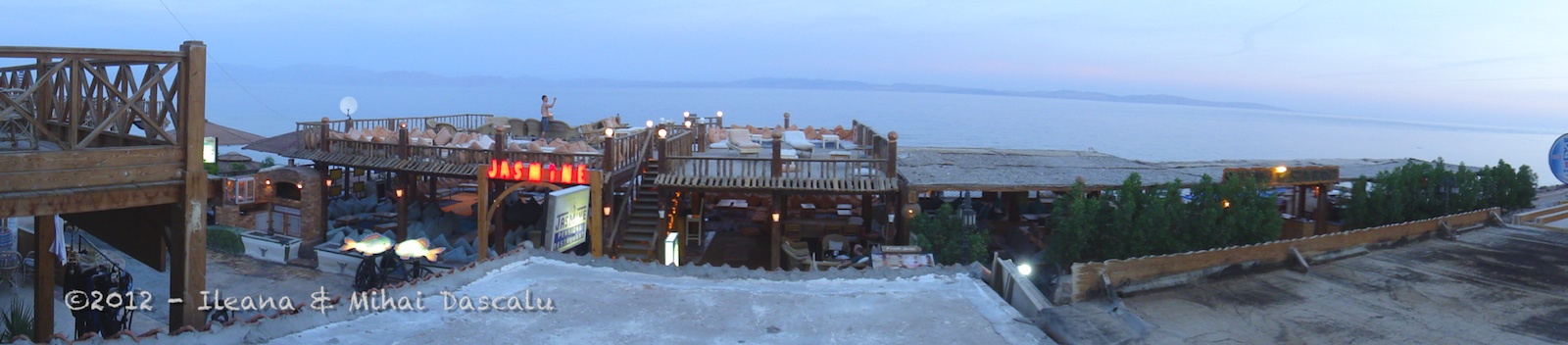
This experience, plus the noisy hotel (there is no fun in being awaken by an hysterical child at 4 o’clock in the morning because he doesn’t want to go to sleep) makes us change the decorum. We pack our bags, pile in a car to the bus station, there we find out that the bus is indefinitely late (it has to come in a convoy from Cairo), we take a private taxi and we arrive at Jasmine hotel in Dahab. It looks more like a house squished between its neighbors.


Mihai and Tito, the manager.

While the rooms are being prepared, we wait on the terrace drinking fresh juice, reading and from time to time glancing at the sea. There is no beach, only rocks, sea weeds, starfish, and practical cats, prowling for an easy meal. There are almost no tourists, there is an easy feeling.


Algae, cat, sea, mountains of Saudi Arabia, sky.


At the check in we have a inkling that Tito has something to hide, he talks loudly, he moves way too much, has large gestures, and he keeps assuring us that everything is going to be alright. Plus we have a CVU (his pronunciation for sea view). The rooms, freshly painted, the fumes trapped by the closed window, are on the cramped style, but hey, it’s an upgrade. We actually booked a five bedroom, so the fact that we get two rooms with AC, fridge and the CVU is an upgrade! “Where is the pool?” asks Mihai.
“I don’t know and I don’t care.” I say, “When was the last time you used the pool from the hotel?” So we snuggle in our separate rooms, looking through the wall wide window at the gorgeous lights of the sunset.


This is not the sunset, but it's much more rare: it is raining cats, and dogs, and hail!
Our life at Jasmine is quiet and enjoyable. The meals are tasty, freshly made from real eggplants, pepper, potatoes, yoghurt and eggs. The people are friendly, they smile and provide us with the cat-gun (a water spray) so we can eat without a begging chorus of mangy cats.

Flat bread, baba-ganoush, hummus, tahini, fresh vegetable, mmmmmmm.

Eating at candle light, sheltered by cut out plastic water bottles. The blond boy is Phillipe, a Swiss, and he has a way of flying toward us in a Superman way. The cat-gun didn't work on him!
Unfortunately the fragile thing called trust is shattered by that persistent question in Mihai’s head “Where is the pool?” There is no pool at this hotel, it doesn’t need one, because it has the CVU. The hotel that has the pool, the one where we made the reservation, it is called Yasmina and it is 1 mile away, white and noisy, with staff that shuffles its flip-flops. The rooms have more space, but they are shabby and come with mosquitos, dripping faucets and a smelly fridge. I don’t want to move, but I have to, I can’t stay and condone this kind of behavior, sidetracking people from their reservation on Booking.com, when they don’t work with that system.


At 8 am. This place will stir alive around 11 am and it will be in full swing around 10 pm.

Just outside the touristic side of Dahab
Beside the better internet, there is one more good thing, for me at least: we’re right next to the mosque! While at Jasmine, our first hotel, I would hear above the waves, that far off voice, low, longing, whispering “Allah u Akbar!” the notes of the prayer call following each other, repeating themselves, reminding me that I can pray too. Now that we live next door, I can hear it at five o’clock in the morning.

While in Dahab we make a day trip to St. Catherine Monastery, on Mount Sinai. We pass at least three control points, just one actually looking in our passports. One line is blocked by tire destructing devices. The soldiers are young, the guns seem older than them. There are succulents growing in make shift pots, around the shack and on the blocked line. Rocks are arranged in between them, lending the desert with a homey feeling. Yes, man sanctifies the place!


The desert is rocky, brown, running camels crossing its paths. We see shabby houses surrounded by cars: bedouin homes. At some point we are required to stop the car: a car is flipped on the ground, 15-20 armed men, not soldiers, are trying to right it. I see a man with a navy blue turban, fierce eyes, shouting. Fear pokes me, I keep my head down while I try to steal glances, I’m the only woman (the girls are lying down on the seats and listen to their ipods). But nothing happens, we are told to move on and arrive with no other events at the monastery.


This kind of mosaics guard the entrance in any town.
It looks more like a fortress, high walls with just a low door.

The wooden enclosures were the only entrance in the monastery until modern times. 

The garden of the monastery, an oasis of green.
The entrance is an enlarged tunnel with stairs that lead to a narrow courtyard. We walk against a current of tourists to see the Burning Bush (it is said that Moses saw a bush burning but the fire didn’t consume it; after that, he heard God). It was transplanted inside the walls in the 11th century and it is fenced in, because people take its leaves as a souvenir.

The one on the right side of the picture is the Burning Bush.

Mosaic of Moses taking of his sandals.

Mosaic of St. Catherine (Agia Ecaterina)
There is a museum with treasures: oldest icons in the world (Christianity had an 57 years iconoclast period, in which icons were destroyed, perceived as idols; fortunately they didn’t destroy these ones), books, religious objects, some of them sent by rulers of my country in the 15th century.

The rule is simple: no photo. “Just ask!” says a voice in my head. The guardian tells me to ask for the priest’s blessing. He looks at me for some time and then “Just two photos.” I am in a museum with so many things, which one to choose, to keep its memory in my heart and in a picture? I am literally overwhelmed, tears sprang, running down my face, onto the heads of my children and my husband’s hands who are there hugging me and helping me to calm down my emotions. These are my dearest:

The icon of Christ Pantocrator (Omnipotent). The stern expression on the right side represents Christ in his role as Judge, while the left side bears the serene expression of Christ the Savior.

This icon represents the ladder to paradise of St. John Climacus, an allegory of the difficult path a Christian should follow to attain moral perfection. As they climb, rung by rung, they are attacked by devils, symbolic of sins and temptations, to make them fall.
We also visit the church, quiet, with so many beautiful icons and mosaics, with doors from Justinian’s times (6th century). On the ceiling there are stars and a cut out crescent, from the times when they tried to transform it into a mosque. They never did, because it was not aligned correctly with Mecca.

The church with its bell tower, behind it, in white, the minaret and the mosque.

Only a glimpse of old doors, hundreds of icons, candelabras with ostrich eggs, mosaics.
For this special time we are thankful to Calin, Adina and their children Ana and Matei, who believed in us, sponsored our trip, and already started a new way of living, so they can follow their dream.

On the short road from the monastery to the car on the sides are people selling alabaster bowls or eggs, patterned rocks, pyramids. They are asking for derisory prices one dollar an egg, a shiny deep milky blue egg. I don’t like to think that they are working hard and sell their work cheap, when in States I would have to pay twenty times more. We’re not buying so a boy starts asking for baksheesh, for a small bribe. “Are you a Muslim or a Christian”
“A Muslim.”
“Does Mohamed teaches you to beg?”
“No.”
“Then I am not giving you money.” He doesn’t have an answer for me, he walks trying to understand but soon he gives up, there are some Russian ladies who at his pestering, offer him some chocolates.


We start driving back to Dahab, only to stop at the last checking point: we are the first in line for a convoy. And we wait patiently, flies buzzing around us, for the cars and buses to come together. There is no military or police car in front of us, no walkie talkie to coordinate everybody, to transport in a group. Just the time, one o’clock, and empty road.

We didn’t know it, but it was the best time in Egypt!