August 4th
Today we climbed on the Amphitheater in the Drakensen Mountains, to Tugela Falls.
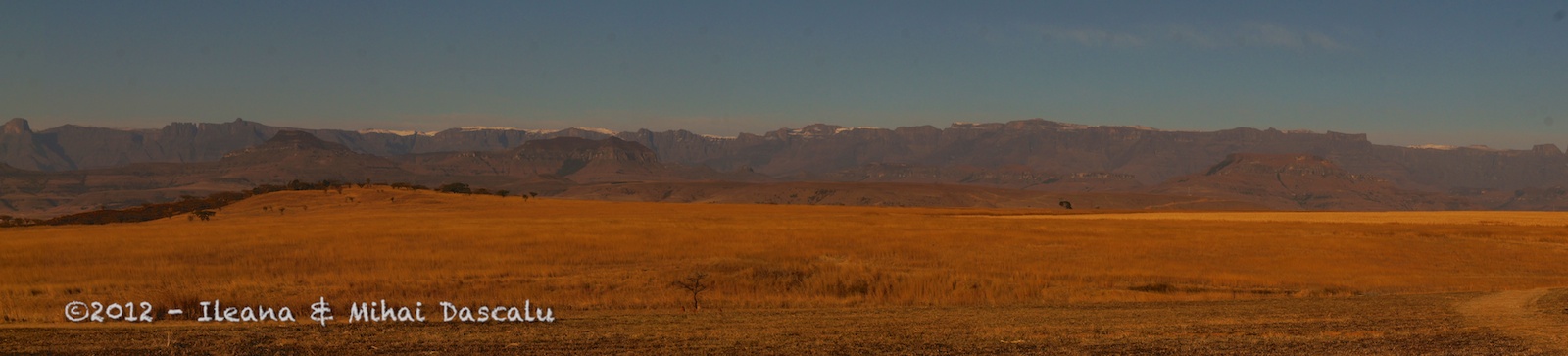
 |
| View from our hotel of the Amphitheater from our hotel. |
We left the hotel (and Maria, who is not a fan of heights) at 7:30 am, drove for 2 hours and arrived in the park at a height of 2500 m (8200 feet). I asked the guide why there are so many burned fields. He said that he doesn’t know, but there are some possibilities: one from smokers negligence, as they throw the stubs off the window; two as a way of renewing the land; three because it is winter and dry, good conditions to have a fire; four when the police is pursuing some drug dealers, they know they are there but can’t catch them. What? It seems like a sci-fi scenario, but it could be true!
 |
| We have to reach just half way. |
From the parking lot we walked in line, behind our guide, steady, very slowly, toward our goal. Ioan got some wheezing, the altitude didn’t help.
 |
| The parking lot is that little white dot on the trail. |
I was always last, it gave me the freedom to stop whenever I felt like it, and I did stop. I’m like a rusted machine, start slowly, but once I’m going, I’m good.

The last part to climb was the most difficult, an almost vertical gulch. There was a little girl who was aloof, teetering, her forces melting with every step (she made it to the end, with no complaint). But the view from the top was more than rewarding. We were on one end of the Amphitheater at 3200 m, we could see almost the whole arch.

We had a lunch break, white neck ravens keeping us company.


We walked toward Tugela Falls, seeing in the distance tourists tents and taking pictures of the flowers.


We met the stream, frozen on the sides, dripping on the side of the cliff.


 |
| Ileana is trying to save a tadpole. |
From here is the way back, a calm, flat walk, toward the back of the mountain. Remember that we climbed up 700 m? Now we had to climb down part of them, on metal stairs, with no equipment (we could ask to be roped if we wanted). There are actually two stairs, one chain like, that is moving when you are on it, the other fixed in the stone, but with not much toe space.

The first flight of stairs was OK, only 18 m (60ft) we landed on a small flat space. We had to wait for the whole group to gather (my height fear caught up too), and then proceed, one by one, on the second stair of 25 m (82 ft). Mihai goes first, so he could film us, then the children, and I wonder what kind of parent I am, how could I do this to my children? I tell myself that they know already how to do it, Tree Top, Tsingy... they had HARNESSES! screams the panicked voice in my head. I don’t have much time to quarrel with myself, it’s my turn to climb down and I do it praying all the time, concentrating on the words, and moving my limbs one by one: right foot down one rung, left hand down one rung, then left foot down, on the same level with the right one, right hand down. I feel the wind, I know that the stair winds following the rock, I hear Mihai’s voice, telling me that I still have 25 steps, Ioan encouraging me, I block one thought of looking down to see, just praying: “ O Lord Jesus Christ, Son of God, have mercy on me” And then is done, from down there it doesn’t seem so perilous as it looked in the beginning.

I hurt my right knee going down, I stepped in an awkward angle and I had to be careful and protect it all the way. I’m not young anymore!
The drive back was not interesting, Ioan tried to sleep but he couldn’t because of the loud music. Maria had a wonderful day, spent it all in bed, writing and working on the camp presentation. She complained that we were deaf, talking too loud and asking her to repeat everything. While cooking the dinner, I talked with an Irishman who spoke Gaelic and English was his second language, so he was exercising it.
We go to bed early, tomorrow we have another long day!
August 5th
Today we went to Lesotho! Our 21st country! We don’t have a stamp to prove it, but we have the exit and entrance on the Monantsa customs from South Africa.
 |
| Our hotel. |
Adrian was our guide and we were on for a ride. We had to drive on the same road as yesterday but today we had explanations. About the dam that has five walls, and you can windsurf on it. Or about the vultures’ restaurant, a hill on which are left carcasses, a gift from farmers, to help raise the numbers of two species of vultures. Or about the people who were forced to move here in the Apartheid era, in rows of identical houses and now they are sporting solar heating equipment (that tells you that they are doing well). He talks and the music is a background. Then, like a DJ, he proudly announces that we are going to listen to the South African Anthem, the real one, not with English and Afrikaans. He turns the volume up and we hear:
Nkosi sikelel’ iAfrika... (ko-see-see-keh-lell-ee-Africa)
Tears sprang into my eyes as I remembered Mandela’s book and scenes from the movie Invictus. He sings along and for a while he lives in the song. Then he remembers how it was when he grew up, a Brit in Johannesburg, going to a white school, where he was forced to learn Afrikaans and then into the compulsory army service for two years. He left, tried his luck in other countries, returned and as he was driving through Cape Town area, he saw people in the streets singing and dancing and being happy “Madiba is free!”. Years later his daughter attended his old school, one of the few white students along with blacks and colored. She knows, but she doesn’t understand what he lived through. “Yes, we have crime, and violence, and all that, but we have freedom!” He is now a proud white South African and he sang along with a catchy tune:
Hey Mr. Mandela, you’re one hell of a fella’
I wanna be like you, I wanna do what you do!
 |
| Adrian. |
By this time we were at the border, got through the formalities, back in the car and ready for the new history lesson, the one on Lesotho. They used to have a shack that served as a customs building, but one year it was damaged, and being the third poorest country in the world, they didn’t renew it. We were driving on a new road (this contradicted what we’re being told), actually in construction and then it ended in a dirt and rock type of thing. Because it was very steep, we were driving slowly, and we were passed by a flock of sheep, the shepherd riding on a colorful horse. These people take very good care of their animals.

Our first stop: the school. Because it was Sunday, there was no one at the school, just a teacher who came especially to welcome us. He told us that years before they had one round hut in which they were doing school. Along came some Irishmen who pooled resources and built a bigger and better, rectangular school. This one became smaller as children poured in from the neighboring hills, so now they have a second building, built with our hotel’s help (part of the money paid for this trip will go to the school). They are hoping that in time they will build a secondary school, so the children will not have to live in a boarding school in a town many miles away.


We walked through the village toward the hills.

A barefoot boy came running, pushing a wheeled stick made from a can and making engine noises. He joined us for a while, then returned to his route.

Later, a girl came and she walked all the way with us. She had several layers of dust on her feet, her shirt and dress were dirty, but she was happy.


After climbing, we stopped at a stone wall on which we could barely distinguish rock painting.

This used to be a San people’s territory and through paintings they told each other which way is the water, where they can find good game and so on. Unfortunately, there are just a few San people now (pushed by other people and integrated in new societies) who can’t interpret them, and many paintings are not protected (in South Africa they are), disappearing under the weather’s erosion or human ignorance defacing.

He told us the history of the Basotho people, how a good man gave shelter to anyone who asked and didn’t want to fight. His name was Moshoeshoe and when pressures came from the Zulus (king Shaka extended his territory), from the voortrekers (the pioneers, white dutch settlers who moved from the Cape Town area because they didn’t like the British rule and their slaves) he moved his people to an easily defendable plateau, in Bathu-Bathu. He asked for the protectorate of the British, and having it, insured the liberty of his kingdom. Someone gave him a blanket as a gift, and he wore it like a cape, fastened over one shoulder. The Basotho people are still doing this. I don’t think there are many changes besides electricity and plastic objects in his people’s life since his time (1870).


After lunch, we made a stop at one of the houses, that had a white flag (it means they are selling beer). We were invited inside, seated on a bench, offered a plastic container filled with beer (the same kind as in Shakaland).

An elder woman, leaning on a stick came inside and Ioan offered her his seat. She raised her hands, and still holding her stick, started dancing. I took a picture of a man who I think had a little too much.


A young man joined our group and talked with each of us in a perfect English. He told us that their houses are round, so the ancestors could help them, that’s what they know, they don't recognize the new, rectangular houses. That school is far away and it costs a lot of money, that he doesn’t have. That is important to learn, so everybody would have a better life. He was our interpreter from the Basotho language to English when we visited the sangoma, the witch doctor. Because we were so many, and we actually didn’t pay for a consultation, he received us in his house (and not his office, which is a separate hut). We were seated some on benches, some on mattresses, he stayed all the time kneeled on the hard ground, with his head down and eyes moving from one to another.

This is how he was honoring his ancestors, by honoring us. He was dressed with a red T-shirt and a red straight, knee length skirt with white beads, with necklaces of white beads and silver bells and decorations of baboon hand, a paw of a powerful lizard, goat horns and so on. They each have their signification (to become a sangoma, he had to sacrifice a goat; the bells are to make sounds when he is dancing at the sangoma conference with his fellows—twice a month) and they where dictated by his ancestors in his dreams.
What Adrian told us, and the sangoma said in his own language, translated by the young man, was that not anyone can become a witch doctor. He was chosen by his ancestors, who send him dreams, and things happen to him, not letting him have a normal life. When people come to him, sometimes he already knows what ails them, because he dreamt them and gives them the treatment dictated by his ancestors. Sometimes he has no idea and has to wait for the recipe to be sent. He is paid in nature, so many eggs, or a chicken, or rice. People don’t have money here. I asked what makes him a better sangoma than others? The interpretation of the dreams.
People in Africa believe in good spirits and bad ones, and many times their first stop when something ails them is at a sangoma (the correct term, witch doctor being reserved for the ones who are working with black magic). Fortunately, they work with the western doctors, helping with vaccination, and sending all the surgical cases and birth to the hospitals.

After this visit, we make another one, to the teacher’s house where we eat with our hands from one dish pap (a white corn polenta) and a green dish (something like kale or spinach). The men drink beer made and canned in Lesotho.


 |
| The interior of the teacher's house. |
A gust of wind threatens to uplift the undulated metal sheets that await to be put on the roof of the teacher’s new house, that he is building it by himself, so more boulders are piled on them. Outside women, dressed in blue skirts and starched white blouses were going to the Zionist Church. This is a whole day service, and the priest, noticing us, invited us inside. It was very short and everybody got outside, where the priest blessed some bottles of water and distributed them.


For us it was the end of our Lesotho trip. Storm pushing us from behind, we piled in the car and drove toward South Africa.

We arrived tired and half deaf, singing Mr. Mandela, we went to the restaurant where we celebrated beforehand my birthday (the food was not good, half stayed on the plates, but I didn’t have to cook it) and talked with two Germans and a Frenchman. And I also received part of my gifts, I talked with our parents. I miss my family.
I’ll have to write Ileana an email thanking for her gift, because these two wonderful days were possible because of her.


