Tuesday, April 17, 2012

Sydney


G’day!
This is what is written above our heads as we get out of the airport’s no-man’s-land. We’re the only ones in line for a taxi, and, this being a civilized country, for the five of us it means a van. There are cameras on top of it and on the doors is written that we will be photographed. Hmm, curious...The driver is quiet, but from time to time he shows us the surveillance cameras installed in different corners of the intersections. He explains that they don’t necessarily improve the quality of the traffic, but certainly help with paying fines for breaking the rules. Later, I will find them on the street, the bus (at least three, one for each section), the subway...I really don’t like all that surveillance, it makes me think of one of the science fiction books...
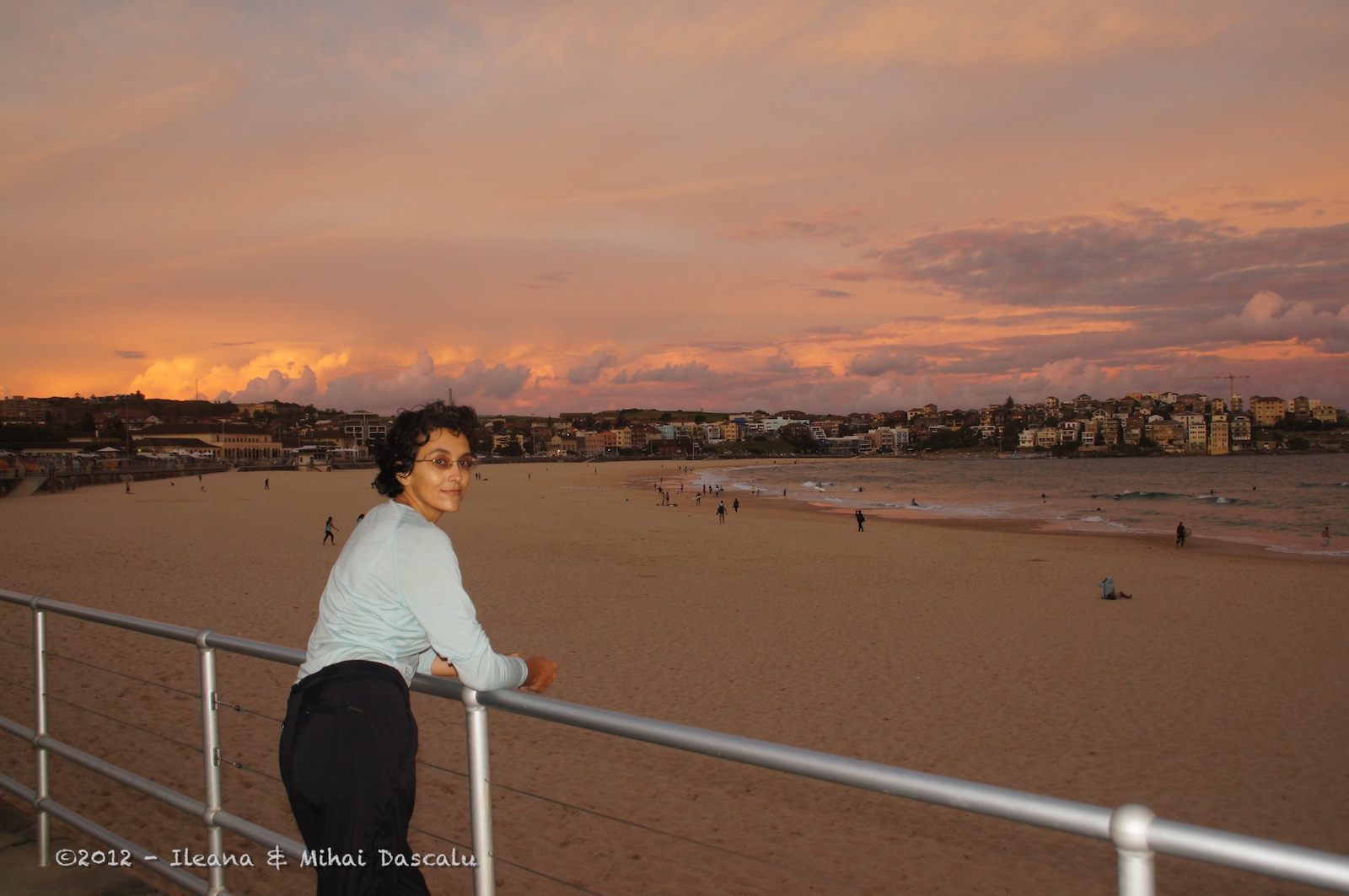
Our apartment is in an old building with cockroaches and windy windows, but it’s quiet (if you ignore the heavy steps from the upstairs neighbor or the phone calls from the side one). We’re here because we’re five minutes away from the famous Bondi Beach. 


Though it is fall (let’s say October for us), it is warm and there are plenty of people in the water, some with surf-boards, some with body-boards and others just swimming.


It is interesting to watch them: they walk on the fine sand, take out their jandals (flip-flops), find a spot, drop everything in a pile, and walk with no worries into the water. Upon returning, they either pick everything up and leave or they just stretch a towel and sit on it.  You’re supposed to swim between the flags, where there is a lifeguard with a surf board, not to play ball games or eat, but all these rules are broken.

The beach is a social place—you meet up with people, the regulars, your friends, someone from work, anybody.  It is a place where you can do your jogging, your calisthenics and, especially for men, show off your muscles. Men of all ages are so buff, they can’t walk with their hands close to their bodies! The social thing spills nearby, where you can find so many opportunities to gather: a coffee shop, a bar, a small restaurant in which the tables are half inside and half outside, so you can keep your dog next to you, and still eat. 


They seem to do this all day long (okay, not in the early morning) and night time too.


 They all dress up, with well-fitting clothes (I have yet to see pants belted under the hips), girls in short dresses and boots, and drink. By 11 pm they are in different stages of inebriety. Some will resist until 4 am, when they will pack their guitar, take some steps, find a new friend and discuss how to beat the trembling road.

I read in the Lonely Planet guide that in 2005 a group of intoxicated whites started a fight with some Middle Eastern people, that exploded in the days to follow in violently expressed racism and destroyed property. That explains why there are signs that forbid consuming alcohol in all public spaces. Suddenly all those surveillance cameras make sense. It seems that the people applied the ostrich stratagem, hiding their heads so they don’t have to confront the problem of racism. In the aftermath, they know they have a problem and they are addressing it. The lifeguards started offering lessons to the minority groups and they even had a girl in a Burkina (a swimsuit that covers all the parts required by the Islamic religious rules).
But even if I didn’t read, I would have realized the situation. Walking the downtown streets I had mixed feelings of childhood memories and that something is missing. I grew up in a country where everybody was like me. I was 15 when I met for the first time in my life a person with black skin. He was a foreign student at the Medical and Pharmaceutical University in Bucharest. The people in downtown Sydney where all white. Dressed up in suits, white collar, blue collar, but all white. I was wondering how come there are no Asians, no Indians, no Africans, only whites... But they’re there, I saw them in the subways and busses. They just don’t work dressed up in suits or downtown.


Our first visit was to the Opera House. The name suggests one thing, but it is much more than that. It is an art center. We took a guided tour and learned about it. The design was rejected in the beginning, because the drawing looked like squiggly lines. When it won, they didn’t know how to build it. Utzon, the architect, came with the solution, to cast the “shells” of the roof as sections of a sphere. 


They are supported by precast concrete ribs, visible in the halls area. 


There is an elevator without roof, so you can admire the beautiful concrete. The interiors are decorated for their purpose, with panels of wood that would enhance the sound.


 In the concert hall there are metal rods and crystal saucers above the orchestra that are lowered during a performance to reflect the sound. The Playhouse has the scene surrounded by chairs, you can view the performance around, if the director envisions it like this. 


None of the stages have a big backstage, because the whole scenery is taken with the elevator, pushed on rollers and in the basement. They have one of the biggest organs in the world (depending on which criteria) with 10,000 tubes, that required more than two years to be tuned up (they have one or two shows a year for it). 


And the view... Sydney Harbor and the Bridge, and the business district. 


It is just as beautiful on the outside too, with matte white and cream tiles on the roof shells, pink granite on the walls, glass and metal in the windows.


 We will come back to see That Scottish Play, “Macbeth”, and to admire once again the building in the lime light.

Another visit was to the Australian Museum, where they had a show with Aboriginal culture. They shared with us songs on didjeridus, songs in one of the native languages, and danced like birds. It was very interesting, and the children present there were eager to join the dance. 


Then we went to visit the Aboriginal section. It had a little sign stating that inside there are photographs and names of deceased people that some Aboriginal and Thorres Strait people could find disturbing (they don’t talk about people who died). The exhibition had a little of everything, presenting the native people who have different names, but just the Aboriginal ones caught. Knowing that we are going to Uluru, where we will learn about it in a different way, I kind of sailed through it. 


Aboriginal art with Rainbow Snake


I stopped to read about being separated from their families, growing in missions camps, having no rights, no land, no nothing, but expected to learn and behave the white way, and be thankful. The Rabbit Fence is a good movie portraying the situation. As usual, the white man, in his false superiority, failed. Around 1970s, pressed by the social movements for the rights of the “traditional owners”, they changed their politics from assimilation to self-determination. From the moment an Aboriginal group submitted the paper to have their lands returned, in some cases almost 30 years passed before having it approved, holding the paper in their hands, and the enforcement of that decision.  Also the efforts of reconciling the two parts, the involving of the Aboriginal communities in the rehabilitation of the youth who are troubled and don’t know how to behave in any of those two worlds: the white one and the traditional one. In 2008 the prime minister apologized for the wrong doing.

In the museum, there were other sections: skeletons of every living and extinct creature, insects, rocks (now they can trace the origin of the precious stones: they take an itsy-bitsy amount, burn it, illuminate it with a special light and that’s how they know if it comes from Africa or some other part of the world; this is good to really put a stop on blood diamonds). They even had rocks that reacted to UV light.

 At the top floor they had an open space with computers, stuffed animals that you could touch (my first platypus), puzzles, books, trays with forest dirt to look for insect eggs (they had a paper showing you what to look for; after sorting them they put them in an insectarium, where they will hatch and grow between leaves and sticks). 
As usual, we left at closing time, but this was the first museum that left us tired, all of us.
The Aquarium was a work in progress. They are currently expanding some spaces, but the tanks were small and crowded, not an easy flow of visitors and the platypus was not swimming, it wasn’t even in the tank. But we saw wonderful sea dragons and big sharks swam above our heads.


The visit that we enjoyed most was to the Apple Store. We had a portable device to have internet access from anywhere in Australia, but it took forever. To upload the blog posts... ugh! But in the store, with their wifi... bliss.


Botanical Gardens and a sculpture of the Dreaming
We arrived in Sydney at the beginning of April. On April 15th we celebrated the Orthodox Christian Easter.
Before I explain what it means to be an Orthodox Christian I have to make a very short and oversimplified history summary. Jesus came bringing the message of love. The apostles spread out His words, wrote them down, discussed them. In that time the Roman Empire was strong and continued to expand, conquering new territories and plundering anything that could be transformed in gold or entertain the crowds. At some point it was so extended that it took too long for messages to reach Rome or the territories, and combined with some political reasons, they had four people to run it. The rulers started fighting each other. Death claimed some of them, but their children continued. And in 312 you have two generals fighting for the crown, Constantine and Maxentius. Christianity started as an unknown religion and spread like fire among the people that made the Roman Empire. Now  the Romans were tolerant of other’s religion but they noticed that the Christians were different: they were willing to die for their belief and not bring offerings to the Roman Gods. It started creating problems and setting bad examples, the rulers were unable to suppress it, no matter how many they were killing. It is said that Constantine had a vision or a dream in which an angel told him “In hoc signo vinceres,” “In this sign you will conquer” and so he had the sign of the cross on every shield. He won. Christianity became recognized as a religion. Constantine chose to distance himself from Rome and the people who wanted to overthrow him and ruled from Byzantium, a strategic city in present-day Turkey, and renamed it Constantinople (now Istanbul). He started building churches and gathered the priests to talk about religion. The Church grew strong in Byzantium, the Eastern part of the Empire. Rome continued to be important, as the seat of Peter the Apostle. Some hundreds of years pass by, the Western territories are changing shape and fight, the Eastern part transformed itself in the Byzantine Empire, but the two parts of the Church are still talking about religion and dogma, and can’t agree on small things. In 1054, after almost two hundred years of different opinions, the two heads of the Church, the East one and the West one, excommunicate reciprocally and that’s when you find for the first time the Catholic Church, centered at Rome, and the Orthodox Church, seated in Constantinople. They both revere the Mother of God, Mary, and pray to saints to intervene for us, but they also have their differences (Catholics believe that Mary had an Immaculate conception, Orthodox believe she was of normal birth, and in the Creed Catholics say that the Holy Spirit originates from the Father and the Son, but Orthodox say only from the Father). As history will have it, they influenced the countries that were close to them. For the Orthodox it was Greece, Romania, Bulgaria, Russia, Belarus, Cyprus, Georgia, Macedonia, Moldova, Montenegro, Serbia and Ukraine. The Catholic church influenced France, Spain, Portugal, Ireland and through them and other empires two more continents, the North and South Americas.
Christmas is a widely known celebration. You can find Christmas trees in houses that are not Christian. Reasons vary from commercial to belonging. Not so for Easter. Though you will find merchandise, it doesn’t have the same echo as Christmas. 
Pascha is always celebrated on a Sunday, after the Spring Equinox. Always the first is the Jewish Passover, then is the Catholic Easter and then Orthodox Pascha. Sometimes, as in 2000, you have them all in the same Sunday, but how they calculate, based on what calendar, though I have read about it, I am not able to reproduce it.
The Church guidelines to prepare oneself for Pascha are clear: 42 days (six weeks) of lent, no dairy, no meat, no alcohol (you are allowed a little wine on week-end and feast days) restrain your eyes from worldly images, your ears from bad words, your mouth from idle talk, train your hands to work for others and your mind to pray. Some will follow these the first week, some for a few days, some will not follow at all, and some will follow every iota. After these comes the Holy Week, with daily evening services, and sometimes during the day. 
An Orthodox Church is built differently from the Catholic one, you can’t go around the altar or behind it. The altar is at the east end, separated from the rest with a wall covered in icons (images of Jesus, His Mother, the apostles, the saints, the last supper and so on) with three doors, the middle one opening only during the service.
On the Holy Thursday, twelve gospels are read, all describing the moments before and after the Crucifixion. The Holy Cross is taken out of the altar and brought in the middle of the church, while the bell rings mournfully. People revere it, cross themselves and kiss His feet or His wounded ribs. 
The majority of people come on the Holy Friday and bring flowers to put on His tomb. Then, with a lighted candle in their hands, sing the Lament, a beautiful chant in three parts with four melodies. When it is done, the priest takes upon his shoulders the Holy Air, a cloth on which is painted or embroidered the entombment of Christ, and circles the church while everybody follows him, sheltering their candles and chanting a very sad canticle. Then everybody reenters the church revering the holy objects and after a short conclusion of the service, we leave for home with flowers.
But for me the most beautiful part is the night of the Pascha. It has a little bit to do with the celebration, with dressing up and being free to eat again anything. We gather before midnight, bringing baskets with food that we prepared for these three feast days: red-dyed eggs, cheese, special dishes made with lamb, cakes that we only make for Pascha. The church, though full to the brim, is quiet. The lights are turned off, there is darkness everywhere... a flickering light and the priest comes out of the altar through the holy doors, carrying a white candle: “Come and receive the light!” 


Like a human wave, everybody comes closer, stretching their hands to light their candles, joy on their faces and in their eyes. They turn around and share their light with others and by the time the priest makes his way outside the church, the light is already there. 


The service will continue outside, a sea of lighted candles and faces, all quiet, waiting. The priest prays, the choir gives the answers and then... “Christ is Risen!” and as a thunder we all answer “Indeed He is Risen!” This is what we were all waiting for, what we knew, but wanted the confirmation. We will return inside the building and continue the service in the wee hours of the morning, then after the blessing of the baskets (remember them?) we gather in the social room and share what we brought. 


On the table you can see the baskets


The hard-boiled dyed eggs... Mihai will hold one in his hand with the pointed end free and facing downwards and I will hold it in the same fashion, but facing upwards. He will say, “Christ is Risen!”, I will answer “Indeed He is Risen!” and then he knocks my egg. The one that has the broken egg gives it to the one who broke it (and he has to eat it).

Pascha for us this year was different because we were on the road. There was no cleaning to do, no cooking, but we could go to the services. We had the fortune to be with the “St. Mary” community, that welcomed and adopted us in its midst. When we left the church that Sunday night, besides the traditional food, we were laden with joyous feelings.

Thank you for all that you have given us!


Sydney in all its Glory


I always liked the name Sydney. I don't know why. It strikes me as a wonderful sound.

We get to the airport, find a taxi, and head off to Bondi Beach (Bon-dye… I really don't understand why, though). The fare is abotu $100, which is standard. We've come from pretty cheap countries, though and the $100 is a bit grating. But it's a relief not to have to take a bus or anything. Our bags get heavier as we carry them longer.

The house we're going to live in houses at least four apartments. It's a light green, the only light green house on the entire street, but all five of us (and the taxi driver) are looking for the number. I think it was 126 or 128 or something of the sort. Possibly even 132. See, I wrote the address on the entrance cards, but I can't remember anything beyond North Bondi… something Parade. You'd think writing it down four times would count for something, but apparently it doesn't. When we locate it, we wave off the taxi driver (I think he was Indian… we liked him almost on the spot for some reason or another, and it was probably because he was Indian) with a smile.


We're in #2. It's a long, thin apartment with two bedrooms, one bathroom, one living room, and one kitchen. The hallway is as you enter, and it forms the entire left side of the apartment. On the right side is the kitchen, then the living room, then our room, then the bathroom. At the end of the hall is the parents' room.

It's a small, cozy apartment with couches so soft I can't sit on them properly without getting seriously worried for my back. The beds are just as soft, but there's only room for four, unless someone beds down on the couch. We would wish that fate on no one, so Mom takes the mattress off one of the box springs and asks me to lay down on it and see if it's sleepable.

It is. I'm convinced, later, that I have the best bed in the whole house, and I probably do. Even when Mom and Dad take the mattress off their own bed, they cannot beat the 2-by-4 slats I've got on my bed. It's absolutely fantastic, and I'm not being sarcastic when I say that.

The entire apartment is cream, except for the parents' room, which I think had a black or dark gray wall. The brightest room is the parents' room for most of the day— otherwise at about 12pm the kids' room starts losing light, and I turn the light on about 3 so I can read my books properly.

Books! The owner of this apartment has so many books it's astounding. He has the entire scholaristic collection of Shakespeare's work. He has some new books, a few Australian classics (I would have read them, but they were a series, and I didn't have time.), and there's always the book exchange as you go out to the beach, which is three minutes away, walking distance.

The first thing I do when we arrive is make a list. I know we're going to stop and rest here a while, and so I'm going to take advantage of it by reading High Fidelity, by Nick Hornby, Gulliver's Travels, by Jonathan Swift, The Lovely Bones, by Alice Sebold, and The Witch of Portobello, by Paulo Coelho.

Of course, it's also high time I finished Oliver Twist, by Charles Dickens. I started it in late Feburary, and it's already April. 

I spent a lot of time reading in Sydney, since we mostly rested. I looked through the guidebook and many of the museums didn't interest us (police museum), the zoo didn't (it's funny how as you get older you start liking the zoo less), the churches/cathedrals (St. Mary and St. James, one with statues and the other with mosaics. We saw St. James, which was absolutely stunning, but not St. Mary), etc.

We knew the things that did interest us— Sydney Opera House, Sydney Harbor, the botanical gardens, the aquarium. And so those were the things we went to see.

Getting to the center of Sydney, where all these things are, takes quite some time. I'd always either have my iPod with me (I was reading books off the iPod too… Faust, by Goethe, How to Read Literature Like a Professor, etc) or a book. Generally we only had to sit on one bus for a long time. We'd go past clothing stores, Apple Stores (we went into both), streets, parks, etc, and then we'd end up somewhere, and start walking toward Sydney Harbor.

It's huge. There's a bridge a ways away, with Sydney Opera House, and people take and take and take pictures. The order of the day is to take a tour, find a ballet to watch, and then go home. We take the tour, with a young man who looks very happy to be here, despite the fact that he doesn't like stairs.

(The stairs were some of the nicest stairs I've ever seen— minimum of height, very wide and long… you could take them two at a time with no trouble… maybe climbing them every day diminishes the awesomeness, but I distinctly remember some truly terrible steps, and these definitely were not it).

The Sydney Opera House is nicer up close, I think. You can see the tiled panels that make it 'sparkle,' and you can see the beams and how they're put together. It's beautiful inside, with beams of wood and beams of concrete and granite on the floors that matches the outside, and windows everywhere to let the light in (I love windows and light a lot).

I'm not going to say any of the funny stories in the tour— it will give you an incentive to go to Sydney, but I'm going to tell you the causes for some of the funny stories, and then maybe you can figure it out:

-  Very little backstage space. There's very little backstage space. There's an elevator into which equipment is put in, and that goes up and down and back up again, but there's little room in the wings, where actors generally change, put on last-minute make-up. It's also where ballet dancers tend to leap off-stage to, if you've ever seen an exit leap off-stage, you know it's a bit cringey to hear a dull thump just a few seconds later.

- Very convoluted passageways. To get from one place to another without walking through the main halls and showing everyone your costume (if you've ever been in a recital of any sort), you have to take a few backstage ways. In the Sydney Opera House, they're so complicated, and there's so many of them, that actors and dancers generally have a guider to guide them around so that they don't miss any cues. 

- Very strict entrance times. If the performance starts at 6:30, and you're not there at 6:30, you're not getting in until intermission. Thus, for the use of presidents, ambassadors, royalty, and the tourists, there are TV screens outside the performance halls that show you exactly what is happening on stage. (That's right. Presidents, ambassadors, and royalty have gotten locked out. We were told very sternly not to be late. We weren't late.)

By the way, the presidents, ambassadors, and royalty getting locked out has nothing to do with the funny story. The funny story is about an actor performing in the piece that was happening on-stage. 

We took pictures everywhere, with the chair, without the chair, with people, without people… though the tiles on the Sydney Opera House are actually cream— white would be blinding, much like snow on a snowy day— they look white. And there's one tile missing which they haven't gotten around to replacing yet.

The nice young man said something about cleaning the Opera House, but I can't remember anything else about the tour save that there were children in it, and whereas the adults asked almost nothing, the children asked a series of questions that 'were really good questions! They're keeping me on my toes!'

Questions such as, "What happened to the usher who locked the actor out?" "How long was the architect of the Opera House not the leader of the project?" etc.

When the tour finished, we went to see how much the ballet would cost… it's way above our price range, with $65 a ticket, since all the 'bad' seats have sold out and all the 'good' seats are still remaining. (Perhaps 'cheap' and 'expensive' would be better words, but since the 'bad' seats are generally 'cheap,' and the 'good' seats are generally 'expensive…'). We looked through the booklet that listed the showings, realized that on Monday, Tuesday, and Wednesday Macbeth was also showing.

The tickets were much cheaper, and so we took tickets for Macbeth on Tuesday, at 6:30pm. 

Of course, this now meant that, with the scholarly editions of all of Shakespeare's works at home, I had to start reading Macbeth. Mom tried, but she couldn't get past Act 3— and she hadn't understood anything of what was going on before. Shakespeare gets harder to understand as it gets older. The language has changed so much… I took notes on every single scene so that I could concretely figure out what is going on. I finished the play literally seconds after everyone had already gone out the door, so the last scene had completely disappeared from my mind.

But we got to the Apple Store, and we looked around, and we downloaded songs, etc. (You see, though we had an hour on the bus, I wasn't about to carry Macbeth, and a notebook, and a pen. I was going to leave it at home, where it belonged.) Then we went to the Sydney Opera House, arrived on time, watched the play, enjoyed it (the witch was fantastic, though a bit creepy because she kept whining). The costumes were modern, due to wanting to 'modernize' the play. Thus Macbeth was wearing jeans and Lady Macbeth had a slit in her gown up to her thigh. Presumably modern costumes make the language easier to understand?

My favorite character was Lady Macbeth— she's absolutely fantastic.


At some point, either before or after the performance day, we also went to the aquarium. The main attraction here was the platypus, but of course the darling creature disappeared somewhere within the tank, and though we looked for it at two different times, for a long time both times, the platypus was nowhere to be found.

We saw sharks and fish and sea dragons instead, and they almost made up for it. There is a section of the aquarium where you walk down through the sea— the walls are painted, and as you go down things get darker and gloomier and there are more dead pirates around. You walk underneath the water, see the sharks swimming in endless loops around and above you, and then exit, using a different stairway. The pictures here are calm, and as you go upwards, mermaids 'assist' you to the surface. I liked the sharks. I'm not sure why, exactly, but I liked them.


We also walked through the Botanical Gardens. It was just a walk, to get from the Sydney Opera House to where we needed to go, but it was lovely to see grass and benches and trees and grass… it was just like a little green island in the middle of a city.

Happy Easter


More often than not we are a few days off in celebrating Easter. It makes sense only to the Catholic and Orthodox churches, they commemorate the same event but cannot agree on a common day. This was one of the most important parts in the big picture of planning this whole trip. I had to find a way for us to be in a place with a Romanian Church. It's not just the Easter day, but the whole time leading up to it, the Palm Sunday, the Holy Week, the Black Friday. We decided on Sydney and it was a great choice! It was good to be welcomed with open arms by the St. Mary Romanian Orthodox Church and we met some great people. It was the first time this year that we heard somebody (other than us) speak Romanian, it was the first time in six months that we could get to a regular service, it was both a little weird and familiar in the same time. It was great, it couldn't have been better. Thank you!


We stayed in a smaller, fancy suburb, North Bondi, just a couple of minutes walk from a fantastic beach. Bondi Beach, surprisingly, is really great, despite being famous, crowded and urban. The weather was good the first few days, then the signs of fall started to show. A couple of days of colder, windy weather plus a couple of rainy days, and suddenly the beach is not the tanning and bathing attraction, just the beautiful site good for a stroll.
We liked Sydney. Interesting is that we spent very little time in it. The Opera is as good or even better than I would have expected. We saw it twice, once for a regular tour and then for a Shakespeare play one evening. We walked through part of the Botanical Gardens, we visited the Australian Museum, the Aquarium and the (catholic) St. Mary Church. Along the way we walked some of the busier streets. Besides that, we passed through various quarters on our way back and forth to the Romanian Church, we used the public transportation and even rented a car for the Easter night service (we got home at 4 am!). That was the easy part. The harder one, especially for me, was to relax and do nothing.
Waking up very early or late in the morning, I read countless hours, occasionally watched TV, or I took a walk by the ocean. We made trips to the supermarket a couple of times and just that. The Internet connection has been a pain, despite paying a lot for it, so it was much easier than anyone would imagine to stay away from the computer.


This is Bondi Beach and our apartment in the center of the picture


I've been waiting for Ileana to finish her series of posts about New Zealand. I finished mine a long time ago, two very lengthy descriptions of what we did and what we didn't do out there. I want to attach some pictures and that has been a challenge. We took a little over 3600 pictures in 19 days of New Zealand. I went through all of them, eliminated 800, but there are still too many. I have selected about 100 and at some point I will upload them along with my posts about NZ. But that is not the hardest part. We all loved it there, at least in the beginning. By the time we left, I didn't like it anymore, it was just OK and I couldn't even explain why. I was relieved to leave that place, and strangely during our couple of weeks in Hawaii, the negative sentiments about New Zealand just kept piling on. I even had a couple of nightmares, that we didn't go there yet and I would have to go. Or that somehow I made a mistake with the plane tickets and we will have to fly again to Christchurch. Horror! I would never go back there again. Just the thought of it gives me pains.
So what was it? Still trying to make sense of it. New Zealand, at least as seen by me in the South Island, is a great country, really beautiful, with very nice and charming people. Almost too perfect to be real, after a while what I made of it was just hills and clouds and fences. All sort of fences. Old people, nice, fit, trim and old. Yeah, old. The country is young, really young, it has really nothing to show besides what God gave it (and fences), but the people are old like they've been there since the beginning. They all look alike, dress alike and talk alike. The history consists of the story of some Polynesians eating birds until they finish them and a professor or two who were interested in nature. And then, they are really cheap. They count the digital channels on TV and advertise that with the motels. Some motels have 3 or 5, the generous ones have 7. They want you to pay for every year of your children's life in the holiday parks. They dismiss the 17 year old one as being adult. They count the megabytes of the Internet connection and make you pay for each one of them. Sometime twice. The lamb or the butter are expensive, almost to make you feel guilty that if you eat it in New Zealand they cannot export it to some other place in the world... Oh, I'm bad. I am sorry.
Here is a quote of what I wrote a month ago:
"Would you move here?" asks my pleasant, third age British neighbor. "NO WAY!" I answer categorically, without thinking for a moment. My answer is so abrupt, that I feel I need to explain. "It's so cold, we came here after a month in Thailand." I am in Dunedin in a holiday park, it's sunny and 21 degrees Celsius, clear skies, and we had really good weather so far. We've been in New Zealand for 15 days, it was good, but we are ready to move on, and for some reason I cannot clarify my feelings about this country."
Now that a few weeks passed my feelings are not good. But it's OK, it is reassuring in a way that we don't like every place that we visit because... I don't know, there must be something. Actually it seems that we like less and less of what we see. We have more to compare to, so we become more selective and more demanding. And we have different taste and like different things differently.
We must be the first family traveling around the world that ends up in Hawaii against their will. An extra $6000, 24 hours on planes, crossing the equator another couple of times and we spent 11 days on the Big Island and Oahu. It was the first time we went there and one of the few remaining states of the union that we had to see. From upstate New York, Hawaii sounds like a wonderful exotic destination. It's nice, but just that. None of us got excited about it, but we had a good moment here and there. The girls took three days to realize that our first hotel has an exit toward the ocean. They gave it a quick look and said "OK." They never even considered paying a visit to the pool. They could tell you all about a shelf of exchange books. The second hotel in upscale Waikiki was five minutes from the beach, so they never even considered going there. But we could all take a couple of hours to describe our fantastic hair cutting experience followed by a working visit to a real, old, traditional coffee plantation. We also liked the Volcano National Park and walking on the lava. The helicopter ride was OK, but none of us is looking forward to repeat the experience. The good news is that none of us have to ever repeat the experience. At least not on this trip. It was impressive and for some of us emotional to visit the Pearl Harbor site. We did it. Hawaii is "just" United States, with the good and bad part that is "just" home. The Walmart sells macadamia nuts and beach towels, and the grocery section is more expensive and less varied than in our little village in upstate New York. You can buy bread crumbles imported from Japan. Unfortunately the great beaches that you hear about are at best pathetic, the surf waves were absent and the traditional Hawaii stuff is only in the expensive "for the tourist" restaurants. I liked a suspended automatic train at a mall. Train in the mall! Ha, the Chinese are still far behind that. The bus on Oahu island is good. You can get a free transfer to a second bus in the price of one ticket. If you attempt to sell that transfer to another person you get 12 months in jail. Oh, how I missed that part about America! The land of the free, where anybody can end up in jail for any reason whatsoever. And they think that is normal and doesn't have anything to do with freedom.
It was disconcerting at first to see some vagabonds and beggars on the corners of the streets, asking for food or some money. I didn't know at first what they were doing, than I realized. These must be the homeless people! We haven't seen those in ages. I quickly learned to ignore them like all my fellow Americans. Still it was good to be home, even in Hawaii.
We've been on the road for six months. It is a good start. We are not yet getting scared that we have to go back. There are plenty more places to look forward to. Since New Zealand we got to take it slower, not seeing something new everyday and not even leaving our apartment some days. (OK, not me, but that's the idea). We are done with the aquariums. We are very selective about museums. We scratched off the possibility of going on the Great Ocean Road (by Melbourne), we just saw the best one in New Zealand so there is no point in repeating the experience. We never even considered going to the Blue Mountains (one major attraction by Sydney), we were in Himalaya and the Southern Alps and will see some other mountains later. It will be a long time until we'll be back in Sydney, but I loved this place and we had a great holiday. In the end that is the important part. Happy Easter!
(note: If you use this blog to get ideas for travel destinations, don't write off Hawaii or New Zealand, they are great places, you only get to criticize them after you've seen them. And enjoyed them.)

Sunday, April 1, 2012

Lava and Bombs

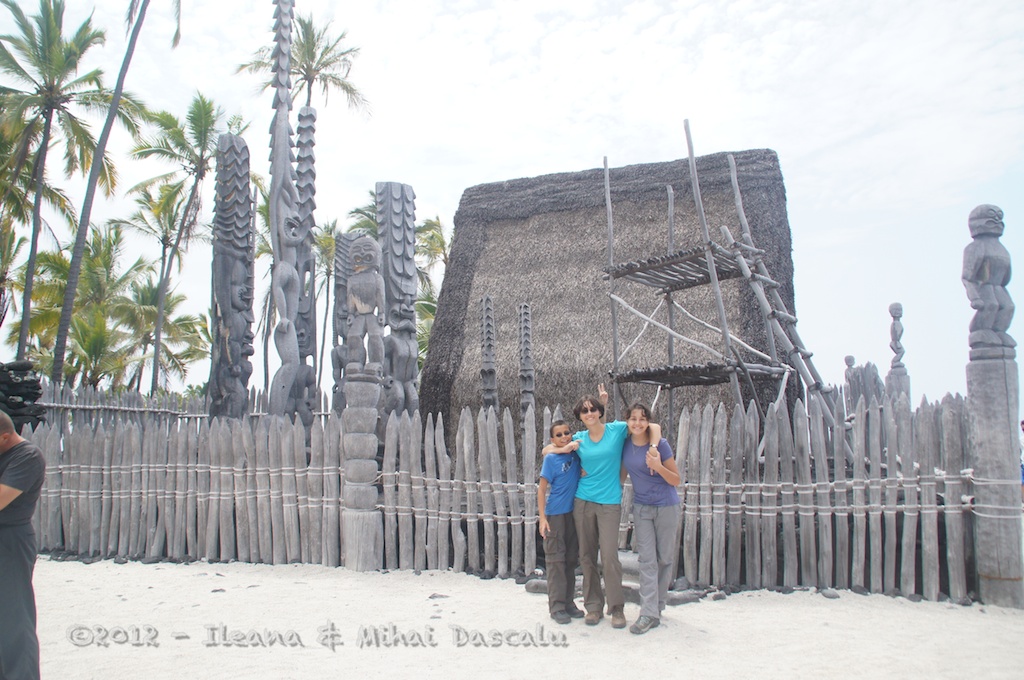
We moved to another hotel, close to the volcano. On our way we stopped to visit Pu’uhonua o Honaunau.

Playing a traditional game.


 It is a sacred place and a refuge one. Hawaii was colonized by the Polynesian people, and isolated here, on this volcanic island, the religion became a collection of rules, of things that you could, or could not do. Breaking the rules would upset the gods, who would punish people by sending a tsunami or an eruption. To prevent this, the chiefs would have to punish people, and sometimes this would mean death. But there was a way to escape: if one could run toward the sea and swim through treacherous waves and currents and get on this ground, it meant that the gods spared him, and so should people. 


There were temples here in which the bones of the kings were placed. These bones had mana, power, energy to protect the ones who were seeking it.  Now they are not there anymore. King Kamehameha II abolished the religion in 1819 and welcomed some months later the Christian religion. 
How do you abolish a religion? Can you control what people believe? Can you stop them from worshiping? A hundred and some years later the Hawaiians are claiming their heritage, making offerings, openly teaching their children the old ways, as they were taught in secret, dancing hula (it was forbidden for a while). It is a private matter, as the island has Portuguese, Japanese and other heritages.
Separated by a lava wall 10 feet high were the royal grounds. The king would come here by canoe and live in one of the thatched houses, had his drinking springs, his sea turtles and his fish ponds. Death would await the commoner who would cast his shadow or even look toward the royalties.

These round holes are the fishes' nests.
We had a long drive on another winding road, with a speed limit of 45 miles/h. The villa was set in an idyllic garden, with fern trees and camellias. Ileana was happy to discover that they had internet and that’s where she spent her evening.


Next day we wanted to visit the park grounds. The weather had a different idea. It rained on and off most of the time. The minute we stepped outside, it seemed that clouds were gathering around us, soaking every plastic uncovered cloth. Still we managed to visit the Jaggers Museum, named after the man who pioneered volcanology, a place where they explain about the Hawaiian volcanoes and Pele, the goddess. Sometimes she’s portrayed as a white dress maiden, or an older woman with a red dress. She takes very good care of her things and is jealous. So jealous that if you take even a hair of lava (formed by explosion of lava in water) her wrath will follow you in many forms. There is no way around it, but to return the lava with a peace offering.

Letter that accompanied a returning piece of lava.


The crater was right there, in front of us, spewing 2000 tones of sulfuric gas daily. It looked like normal clouds, changing their shape in the wind and rising. 


The lava was not visible, as it was hidden by the crater’s wall, but in the night time, an orange glow, reflected from the cloud, attracts people.

We saw the steam vents from the car, but ventured on foot for half a mile to see the sulfur ones. 


On the right side in the middle you can see an offering wrapped in a leaf.


Then it was time to go in the Chain of Craters Road, a succession of cones and different types of lava. Again my mind raced back to the Galapagos Islands. The landscape seemed the same. Yet, it was not. Here we were by ourselves, there we had a guide; here we can stop only in places where we could leave the car, there we had the freedom to walk as we pleased. There we walked on 500 years old lava, here is merely a baby of 18 and danger is hidden in its tubes, as they could collapse or explode. 


All this is new lava, but with different qualities, depending on the solidifying temperature.


Life...
At the end, the sea. It’s a cliff with a drop of 150 feet. The glassy blue waves are pounding the lava with fury, just to be transformed in foam and droplets. One by one they are taking minuscule amounts, just to churn and hurl them back. In time, the cliff erodes and then, weight unsupported, it drops in the sea, changing faces.


We’re too cold and too wet to take any other hikes so we return to the villa, where we prepare to change again our domicile.
Last day on Big Island and we take a helicopter ride to see red molten lava. We wait a little bit to see if there are conditions for a flight. We’re six for this ride. We receive a yellow pouch, the life vest, to wear all the time. We are instructed what to do, and it occurs to me that I have to pay attention to these ones, as they are different from the airplanes ones, and the aircraft is so small. 
It is time to board the helicopter. The blades are rotating 12 feet above the ground, but still, I feel like I should bend. We’re taken two by two, four in the back, two in front and the pilot on the left. We have headphones with noise canceling and microphones to talk between us and the pilot.


 We’re still on the ground, waiting for the green signal. And then... tail moves up, making us slide forward and with a little lurch, we’re airborne. The vibration shakes us in a round fashion, but it’s OK. As we fly at a 300 feet height we can see everything: houses, roads, plantations, the macadamia factory. The pilot tells us facts that wash over our ears but then we start listening as he tells of people that used to live there, of his thoughts of buying a place there, only to be covered by lava three years ago.


The problem with a neighboring active volcano is that it erupts, but the lava doesn’t flow as you want it. Sometimes it comes toward you, with a speed of 30 to 60 miles an hour. You have little time to evacuate. There is no insurance for this kind of things... The land is still there, even if it is covered with black lava. The authorities can’t stop people from going back to rebuild their houses.

We look through the windows to see a street partially obstructed, a clump of green trees on a small hill surrounded by silvery lava. This one is still hot, still moving under a thin crust. 

You can still see the streets.


We turn round and round to find that red eye of running lava. It is exciting and sobering in the same time: we’re witnessing the birth of new land that layers over human dreams. I side with the Native Americans: we can use the land, but we can’t own it.

Tour done, we exchange opinions: it was interesting, but we won’t repeat it.
Good bye, Big Island! Hello Oahu!
Our apartment is close to the famous Waikiki Beach.


 We ride the bus 19 for almost an hour and after settling down, we leave the children in front of the TV, as we make our way to buy food. We’re armed with two backpacks to fill with staples. Food is not important for any of us. As long as it fills us and it has a good taste it doesn’t matter if it is from the store or restaurant. And being back on American soil gave us the opportunity to indulge in some favorites and missed foods (bologna). Being an island, everything is expensive, as it has to be transported by plane or boat. For example a gallon of milk is $7 in the same chain store that on mainland charges just $2.89. Now apply to all things.
We have little that we want to visit here so we spend the days inside. The children are taking their annual tests. We take a walk to the beach, and Apple store for updates, through the streets flooded with Japanese people. We visit the aquarium where we learn about corals,


 the intelligence of the octopus 


and other sea living creatures.

And we go to Pearl Harbor. There is plenty of information out there about it. What happened there? People died. The Japanese surprise attackers died. The American soldiers who were not in a war yet, died. The civilians who worked on the base or helped in the rescue died. What you can see is a visitor center with a map of the world in 1941, painted on the sidewalk, different exhibits about each step of the attack, a theater were you can watch a movie, a rotunda honoring the names of those who lost their lives, and then a ferryboat takes you to the monument. 


It is constructed over the ship Arizona, that lies where she was sunk. Oil still seeps out of it and in several places you can see her rusted hulk. Written in black on white marble are the names of the people who died within. On a separate plaque there are the names of the survivors who joined along the years their shipmates. Every year on December 7 people come to honor their names. There are other names to be honored in Nagasaki and Hiroshima, where nuclear bombs were dropped over unsuspecting civilians. And in Auschwitz, and Dachau where people were killed because they were labeled as Jews or Gipsy, and all over Europe, Africa, Asia, Australia and the rest of the world with its waters, caught in the fight for their countries and the pacts that tied it on one side or another of the second World War. 


We have no power over the past. 
We have no power over other people, in what they believe, think or eat, how they dress or behave. 
There is no person better than another one. 
If we want to survive, we need ALL of us and the land to live on it.
On the Waikiki Beach there is a statue of the Duke Kahanamoku, the man that brought surfing to the world’s attention. On it’s base is his message of aloha, that means affection, peace, compassion and mercy.

The first step is difficult...