Showing posts with label palace. Show all posts

Monday, December 10, 2012

Istanbul


What?

You thought that if we bought tickets to go home, we’re really going? And skip this beautiful city? No, no, no, no... too many ties to my country’s and the world’s history. Nope, we had to visit, even if is just for four days.

Leaving the warm Egypt, we prepared for a thermic shock: Istanbul is with ten degrees latitude North of Cairo that translates in a difference of almost 40 degrees Fahrenheit in temperature. We layered all our clothes and hoped for the best.

These ladies are not playing, they're cleaning!


Merhaba (mare-hub-ah)! Hello from Turkey! From the airport we take the metro to the center and from there we want to take a taxi to our hotel. Too bad they are asking for an exorbitant price, apparently they have to drive longer from this side of the road. OK, we’ll cross the road on foot. A nice gentleman shows us an underground passage and takes us to the tram station. Did I say nice? Scratch that, he did it for a baksheesh. We’re not taking the tram because from this point the tickets are the same price as a taxi (and this one can take us to our hotel, we don’t have to search for it). It’s dark and we’re driving on one-way streets, round and round, visiting two more hotels to find ours. It looks like a house! That’s why the taxi driver couldn’t find it! There is no reception at this hour, just the guardians for the night, but this is no problem, they knew we were coming, and now that we are here, let’s go to our room. They are talking in Russian, we in English and Romanian. The room, supposedly for five people, has a double bed, a twin and a love seat. With us and our luggage there is no more walking space. We can’t fit! No problem, let’s look at another room: this one had a little bit more space, the furniture was the same. “Take both rooms!” And that’s what we did, and paid just for one, as the beautiful Turkish receptionist told us the next morning.

We sleep in, almost miss the breakfast, and get out in the drizzling rain to visit. First we stop the old hippodrome, now a pedestrian area. They used to have horse-races here, turning around Constantine’s column (a brick and mortar square prism, stripped of its former bronze sheets). A few steps further, a column made of entwined serpents (that lost their heads in the seventeen century) was brought here in 324 AD by Constantine the Great from Delphi. There it had the role of reminding people of the Greeks who fought and defeated the Persian Empire in 479 BC, here it helped in building a city, Constantinople, worthy of the new capital of the Roman Empire. And some distance off, an obelisk, a true Egyptian one, taken from its temple in Karnak, Luxor. It was raised there in 1490 BC by Tuthmosis the Third (probably as an offering so that he finally could reign after his stepmother Hatshepsut) and brought here by Theodosius the Great in 390 AD (his people didn’t have the same skills, so he had it cut in three, just the top part survives).

Constantine's column (with Ioan), the Obelisk, the Blue Mosque


We enter in the courtyard of the Blue Mosque and while we wait in line to enter (the mosque is closed several times a day for services) we start talking with an Ethiopian woman who lives in Washington DC. To hear American English, even with an accent! This is a sign that we start missing home.

The model of the Blue Mosque


We take off our shoes and enter: a vast penumbral space, cupolas, walls covered in blue glazed arabesque tiles, a wall to wall red carpet, an imam explaining the Faith in English over the sound system, huge candelabras hanging from a drape of wires.


The dome seen through the candelabra.

Tiles


On a column there is a faucet that used to drip water in the marble basin below; on the entrance wall there is a wooden screen, separating the women worship area. The majority of men left, but they, young women, older ones, children, are still here prostrating, praying.

Hagia Sophia seen from the Blue Mosque


Passing through the exit gates we see in the distance Hagia Sophia, the church built by Justinian in 532 AD. It was one of the marvels of architecture in that time, and surpassed only by Brunelleschi’s dome, almost 900 years later. That was the time when it was transformed into a mosque (after Constantinople’s fall in the hands of Ottomans in 1453), had its gold mosaics covered with painted plaster, added four minarets and became the inspiration for the Blue and Suleymanyie Mosque. It’s darker in here, the windows are way up high, under the dome, giving the impression that it floats on light. There are round candelabras on which U-shaped glass coverings hang down, each protecting a huge fluorescent bulb. They remind me of the oil lamps in the oldest synagogue in Goa, India. I used to regret its transformation into a museum—my Christian mind telling me it should be a church once more—but now, seeing Allah’s name in that beautiful calligraphy next to a mosaic of the Mother of God and cherubs, it feels normal.

Looking saint-like


As we walk through its columns and arches, we see two huge round vessels, made from one piece of marble, brought from Pergamon by the Muslims to hold the water for cleansing. Held open by the raised floor, the bronze doors from Tarsus were brought by the Christians. Upstairs there is a marble door, that has an erased cross on it (don’t do unto others as you would not have them do unto you: Christians erased Egyptian gods, Muslims erased the cross).


For one day we had quite enough. We eat grilled corn and look at the people making pomegranate juice.

Steamed or grilled corn, grilled chestnuts and a fez seller.


Sahlep with cinnamon

Sahlep, the healthy drink with orchid buds and several other ingredients


We pass several buildings, which are, believe it or not, water fountains! They each have an inscription saying who made it and why, and in the old times people would come and fill their vessels. Now they don’t seem to work, either because it’s winter or they are transformed in monuments.


The next day just the parents brave the elements. It’s raining cats and dogs, the staired street is transformed into a waterfall and we’re headed for the Bazaar.


Arcades, one after another, the jewels’ side, the shawls’ side, the souvenirs’ side, the potteries’ side, like a colorful maze. Sometimes they end with a simple food stall, where they serve chorba, a soup with vegetables, sometimes with meat.


We return to the streets and stumble on another mosque, the Suleymanyie. Part of a complex, it used to be in the vicinity of a hospital and a college for medical arts, schools for Qu’ran and for the hadith (sayings of the Prophet used for the understanding of the Qu’ran and in jurisprudence), a primary school and a kitchen for the poor, Caravanserai (inn) and public bath. We enjoy the beautifully restored mosque and a traditional desert, ashure.

Getting ready for the prayers.

He is right there, third fountain from the right


On my bucket list was a hamam, a Turkish bath. And because of Suleiman the Magnificent (who ordered the above bath) and of the intrepid people in the tourism business, I can share this experience with Mihai. We enter a large hall with seating areas on pillows around low tables, its walls covered in changing rooms.


They give us towels (I get a two piece covering), wooden sandals, show us the bathroom and then ... the hamam. The octagonal domed room is covered in white marble. Light filters through small round windows onto an octagonal heated slab.


There are some Russians hogging the place for themselves, but we find a little bit of room. The masseurs are coming from time to time, asking us if we are ready, taking the others in the massage corners. Loud slaps, water sloshing, tepid drips from the ceiling on my body, heat melting my frozen muscles (as it is my turn now to hog the hottest spot). After almost an hour, when I start feeling that I don’t have enough air, I concede to the massage. I get the sultan’s favorite spot, next to a shell-sink with no drainage, with brass spigots one on top of the other. Mihai is right in front of me, seated on a minuscule chair. I am ashamed, but I forgot my masseur’s name, was it Yadir? With a towel over his middle, skin taught over muscles, he drenches me with bowls of water, then takes a loofah mitt and starts peeling my skin. From time to time he cups his hand and slaps my body, enhancing the relaxation. Then drenches me some more, over my head, my hands, my legs. He pours water over himself. Dirty water drains through channels in the floor. He tells me that I should move on the marble table and helps me get up. He holds my hand firmly, lest I should slip. Face down, I keep my head turned toward the room, to see Mihai and what’s going to happen next. From a bucket with soapy water he takes a pillowcase, opens it up, then makes it like a bag filled with air and squishes all the air out of it, making mounds of foam in which he covers me. It smells like laundry soap from my childhood. Then the best massage I’ve ever had in my life, better then the Thai one or the Balinese with hot stones. Iron fingers and grips knead my muscles, my knots, my bones, finding all the painful points and dissolving them. He moves my limbs with ease, never approaching “personal” areas. After this, back to the tiny chair, washing my hair, massaging my scalp, water, water, water. I feel so light, so carefree! Teșekkürle (tesh-eh-koor-leh)! Thank you! Yadir’s part is done, but the experience is not. We return into a little hallway where we are air-dried, a man blowing air by snapping a towel toward us, then he wraps it around our waist and another over our shoulders, a kerchief over our heads.

My Lawrence of Arabia!


He motions us toward a stone bench, where we cool down, while sipping an apple tea. It is quiet now and we just sit, no thoughts, enjoying the moment.

We have a different spring in our step as we go home, buying doner kebab and another kind, like the kokoritzi from Greece. The children have several reasons to be happy: they had their own schedule, in bed, in front of the computers; they get to know about our experiences, they don’t have to try them, they get food and two happy parents.

Yarim and his wife, making doner kebab on the spot.

Fistik (pistacchio), chocolate, walnut baklava, and several kinds of Turkish delight.


On the last day we visit the Basilica Cistern, a water-proof columned space that held water for the city’s needs in Justinian’s times (6th century). Again there are slender marble columns brought from all over the known world, for centuries doing their duty of holding multiple brick domes and the weight above them. In one corner some of the damaged ones were replaced with four times their dimensions of reinforced concrete.


An unique model, reminding of the Hindu lingam.

If the column was too short, they used a Medusa head. Hayden was here too! (see his blue chair)


A quick detour to the Archeological Museum to admire the craftsmanship of the Alexander Sarcophagus, named for the war scenes of Alexander the Great against the Persians. Besides other things like treasures from Troy, we found an inscription from Jerusalem, about the Siloam tunnel, built in the king Hezekiah’s time (8th-7th century BC) to bring water to the city in siege times.

The same motion as in the Pompeii's mosaic

Alexander Sarcophagus

Why did it have a bird head?


La piece de resistance is Topkapi palace. We move through the courtyards and the buildings that surround them, visit the Imperial Treasures, admiring jewels, daggers, thrones. One of them was from an Iranian shah, who invaded the Mughal empire, an intricate and elaborate precious gold inlaid with enamel, pearls and emeralds. “You have what you give” is a Romanian saying, in this case what was taken from you. In all our visits through India we’ve never seen such a thing, I’m glad that this survived. We enter to see the Holy Relics and this is the only place where we stay in line. I doubt that Aaron’s staff or Jacob’s head cover are the original ones (especially the head cover, it’s so white and complete) and tend to scoff at the reverence with which the Muslim regard the tooth and hairs from Muhammed’s beard. Then a thought humbles me back, I do the same for the Holy Relics of the saints. Faith makes miracles possible!

Bosphorus and another continent.

People in the countryside still wear the traditional outfit.

Iznik tiles decorated with gold.


We walk through the gardens and enter different kiosks, mother of pearl inlaid in ebony, marble and semiprecious stones. I wonder how many of the people sat here admiring the Bosphorus blue waters were fed with wheat brought as a tax from my country or how many children, taken from their families, forgot their language in this palace, and grew to be the perfect Janissery (a soldier)? How many decorations in here and in places long disappeared were paid with the gold transformed labor, hunger and the suffering of simple people, by contenders to the throne of Walachia or Moldavia?

This is the story of every empire and while we admire the progress and the crafts of that time, the treasures hoarded from their known world, we tend to forget the political and economical print on the conquered territories.


Done... We’re done! We get to go home now! Home, to our country, to our families, to friends and relatives, to places close to our hearts...

Elveda, Turkey! Good bye!

The Gate of Salutation (only officials and foreign dignitaries allowed in the old times).

Hagia Sofia seen from the Topkapi Palace

Sunday, November 11, 2012

Agony and Ecstasy

We board the flight to Milano. People are talking, the stewardesses are nowhere to be seen, while a voice says in Italian “to click the seat belt as it is shown”. It makes me laugh out loud, causing some heads to turn around like, “What’s so funny?” By the time they repeat the message in English (with a heavy Italian accent), the stewardesses are there to do their duty. After we take off, I think we have five minutes at the cruising height and then we start the descent, with a searing pain in my ears and hysterical cries from small children (why do they have to go down so quickly, not giving us time to equalize?)

And then, buon giorno Ee-tahl-eeah! Good day, Italy!

We have three weeks in Italy, and the plan is to visit Milano (only because the airplane takes us there), then we go to Turin, to see our pen pals Federica and Maria Rosa. From there to Florence for four nights, Venice one night, Napoli and surrounding area for six nights, finishing in Rome with five nights.

This is a touring marathon, a masochistic demonstration of how much one can absorb without getting sick of it.

The Boxer

There is no other way, because in Italy we can find not only part of the Romanian roots, but one of the greatest empires, through which Christianity spread and the place where the Renaissance appeared.

The Romans were good soldiers. They fought with the neighboring territories, conquered them, learned everything that they knew and took it one step further. The invention of the arch enabled them to build higher, creating cities with large populations. Through terra cotta aqueducts they brought water from the mountains, feeding numerous fountains in piazzas. People would fill their amphoras and carry them home. Whatever jobs they had, they were away from home, so they would serve lunch at one of the tavernas close by. The rich people would serve dinner in the family, the others would eat at the taverna again. Changing the government form from republic to empire meant distracting simple people’s mind from politics through entertainment. To pay for it meant raising taxes or conquering new territories. And because they were good soldiers, and they were organized and had everything standardized, it usually meant fighting with the new neighbors.

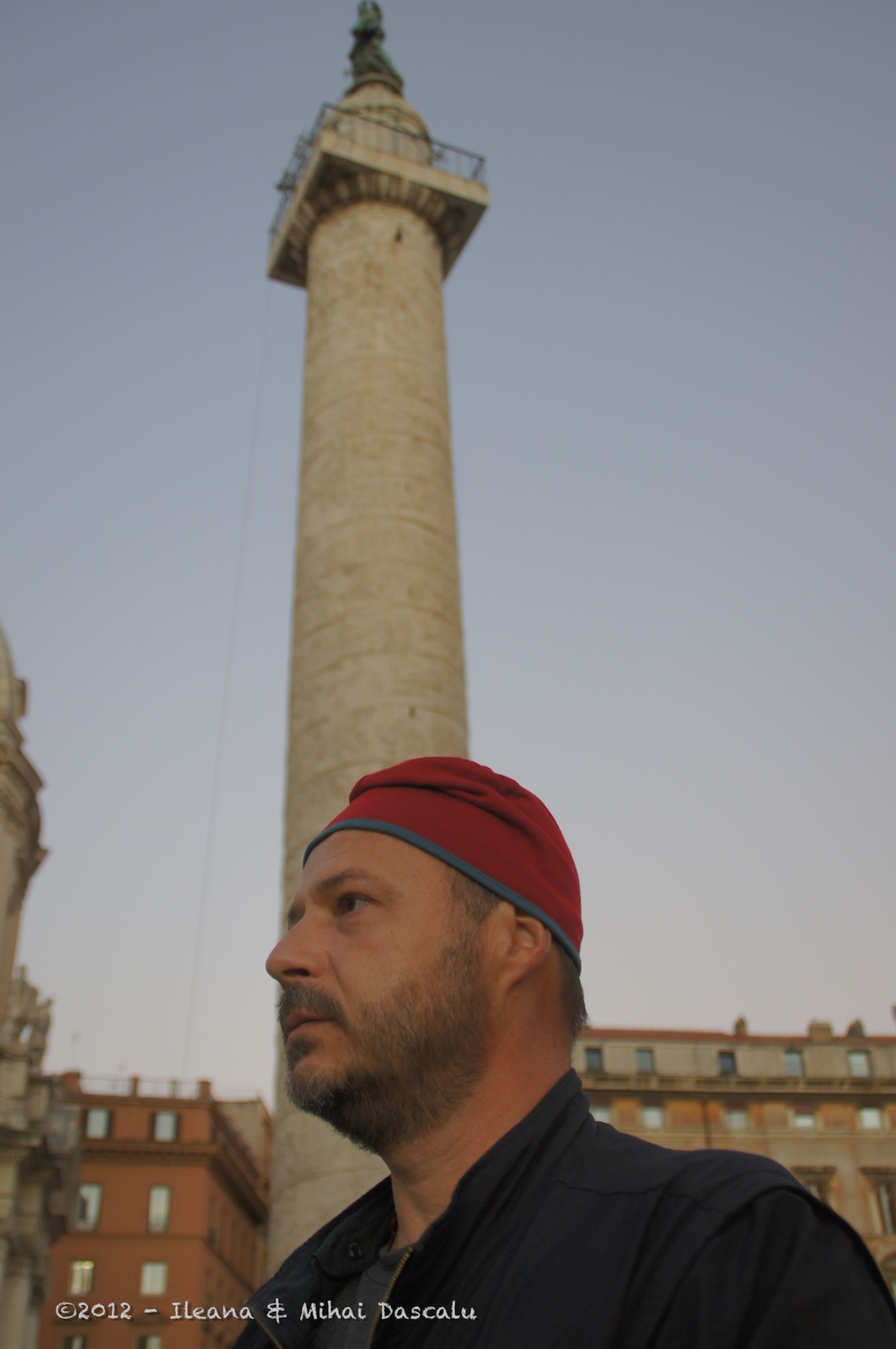
Trajanus
The Dacians were on the North side of the Danube river and kept pestering the Roman authorities on the South side. Maybe they wanted to create their own empire, maybe there is another reason that was not written down. Traianus decided to give them a lesson. It took him two wars in six years, a bridge over Danube built by Apollodorus of Damascus, a wonder of technology of that time, and many dead soldiers to finally extend the border. With the loot, he ordered a celebration one hundred and twenty-three day-long (that’s almost eighteen weeks or four months) in which the Roman population received free bread and circus in the recently built Colosseum. He also ordered a new forum (office center) and a column, by the same Apollodorus, in which the tale of the two Dacian wars is told in an ascending two hundred-meter spiral. The Dacian nobles that were taken captive impressed the Romans so much with their dignity and nobleness that they built statues to them and we had the opportunity to view some of them. The impression was so strong that even a hundred years later the newly conquered barbarians (people who were not “civilized”) were represented with the Dacian way of dressing.

A noble Dacian (we know because he is wearing a hat)
In Dacia, the Romans built roads, for easy access to every corner of their newly enlarged territory, baths and temples for the comfort of the colonists, and Latin became the official language. In time it became the Romanian language.


We saw the Column from a distance, golden in the sunset light. We came as close as we could, tried to make out the different figures and tried to impersonate our ancestors, wearing the hats in their special ways. I even sang two Romanian songs, making my children wonder if they really know me (“Căciula/ The Hat” and “Pui de lei/ Lion Cubs”). After that we told them the story of Gheorghe Cârțan, a Romanian guy who in 1896 walked all the distance from our native country to see the column. Not knowing anybody in Rome, he slept next to it, covered in his sheepskin overcoat, causing the Italians to say that a Dacian descended from the column. I feel proud of my heritage.

Doesn't he look Dacian?
We visit the Roman Forum, sunken by the rising floor of modern life, where temples mix with triumphant arches and churches. They are more or less ruined, depending on how much their material was used for a new construction. In a building that used to be a temple, transformed into a church, icons (painted al fresco) are restored.

At one end is the Colosseum, with panels explaining part of its history, of its working parts, the elevators that could bring wild beast in different parts of the arena, against gladiators or martyrs. There are no cheers or jeers now, but a din of languages and the clicks of cameras. It is difficult to imagine the violence and fear, the flowing adrenaline or disgust in this dilapidated and partial reconstructed place.

Pope John Paul the Second blessed the cross that's in the middle of the picture.
The Arch of Constantine, a mix of new construction with statues and reliefs from other monuments, commemorates his victory over Maxentius in 312 AD. And because “In hoc signo vinces” (in this sign, you shall conquer), namely the cross, Christianity became an official religion spreading far and wide. Constantine ordered a huge church and a statue of him that would salute the crowds to be built.

These were the chapels, above them would have been a huge dome.
Its remains are decorating a wall in the Capitoline Museum, at the other end of the Roman Forum. In the same museum survives an equestrian statue of Marcus Aurelius, thought to be Constantine blessing the people, and a statue of the Capitoline Wolf, the embodiment of the legend of Romulus and Remus, twins cast away in the Tiber river who were rescued by a she-wolf and founded the city Rome when they grew.


I used to feel frustrated because we can’t see anymore the way the ancient Romans lived, but then I realize, they didn’t change. Yes, they have modern ways of building, but their houses follow the same plan, with a high domed ceiling, elongated arched doorways and windows with wooden shutters, tiles on the floor and walls, an interior courtyard with balconies adorned with geranium terra cotta pots and drying laundry. They still eat out, they still talk with their hands, they still dress up (especially men).

The surviving part of the Ancient Rome is spread out in the territory and concentrated in museums. Only walls remain on their original site. Forgotten, destroyed or treasured by the Christians, they were rediscovered, collected and became a source of inspiration for the Renaissance.

Wikipedia says that it started in Florence, because of the civic and social particularities of the city, of the patronage of the Medici family, and of classical knowledge scooped up by the Ottomans after conquering the Byzantine Empire. It brought, beside linear perspective and a more natural way of rendering movement, an educational reform.

Firenze (fee-WREN-zeh, as the Italians say), has a maze of streets, with narrow sidewalks, cars parked a hair’s width from the curb, on which miniature buses with eight seats shuttle people around the major attractions. And every time I find my way blocked, it is just to lose myself in different times between artists’ works of art.

Interior courtyard at Bargello Palace.


Vincenzo Gemito —The fisher boy
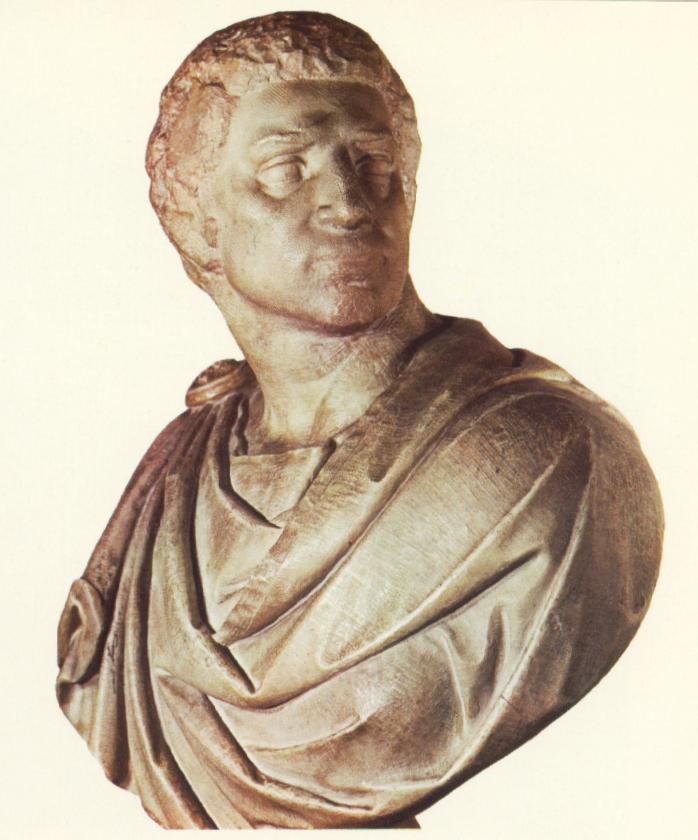
I think that even if we lived for a month in the city, we wouldn’t finish everything it has to offer, so we had to choose. Palazzo Pitti (Pitti palace) with Rafael (just one masterpiece less than the Vatican, which has the largest collection), Rubens, Artemisia Gentileschi, and so many others presented in the beautiful rooms that used to be lived in by the Medici family. Bargello Palace with Donatello, Benvenuto Cellini, Della Robia, Michelangelo (it is my personal quest to see everything that he did.) Some of them I know, his Dionysos has the same happy-drunken face. It is Brutus that stops me in my tracks, the despise and hate, all on his prideful face.

courtesy of web gallery of art
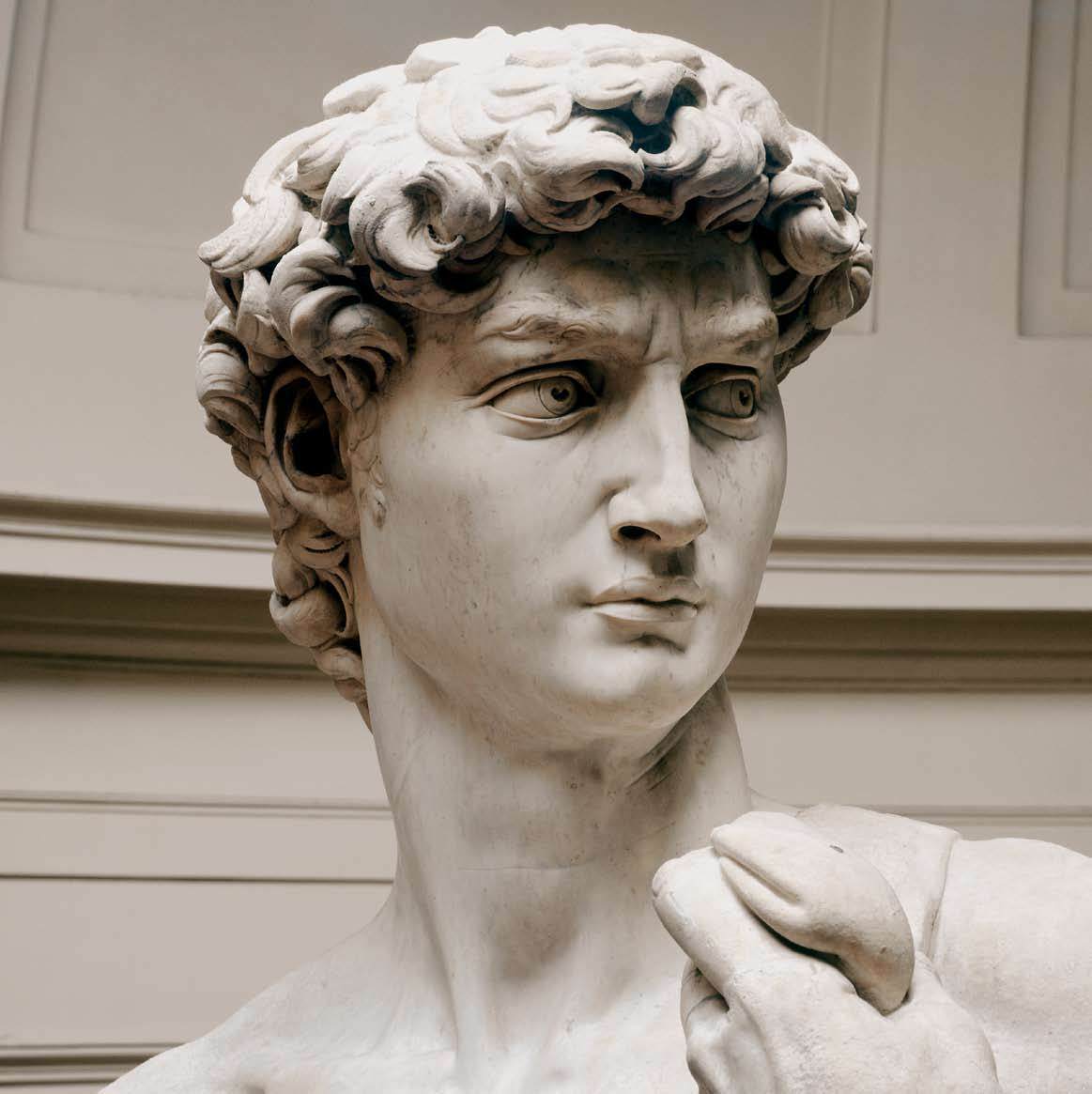
David had the honor of having the Academia built for him. People move around, admiring him, discussing his perfection and his defects (his right hand too big, his arm too long), trying to capture a photo on the sly (only to ignite a chorus of “No photo please”). His expression is different from different angles: eager, concerned, sure, concentrated.

courtesy of web gallery of art
Around the world’s museums there are works of art belonging to wonderful artists. Not all of them are extraordinary. The National Gallery in London has some clumsy Botticelli. But looking at Primavera in the Ufizzi Gallery I just want to stop and look. People chatter around, cross my gaze, still, I am alone with the painting: the flowing robe, the dainty sandal...


detail of the sandal
And things don’t stop here. Here is Bruneleschi’s dome, the first and largest dome built since Hagia Sofia (532 AD by Justinian in Constantinopole).

The Dome in the background
He brought food and drink to the workers, in order to keep their energy for building and not for climbing stairs. He invented different machineries for lifting and transporting stones along the river.

A barge with wind- and water-mills
Going in spirals, wondering when I will reach a platform, squeezing between grubby stones and fellow beauty-seekers, almost crawling in places, I reach the inside cupola and Vasari and Zucarri’s work. It is the Apocalypse scene and a very busy one. In a geometrical pattern there are black holes, some with candelabras, some without (I presume they are the holes left by scaffolding when the painting was done). We continue upwards, more stairs, between the two cupolas, to a sea of red tiled roofs.


And if this is not enough a short walk from the dome, is the Baptiserie with the Ghiberti’s gilded bronze doors. More than six hundred years ago he rendered scenes in linear perspective with a finesse possible only through his reinvention of the lost-wax technique. The originals are in the Dome museum, literally steps away, because the humidity and temperature differences produce bronze salts that makes the gold fleck away.


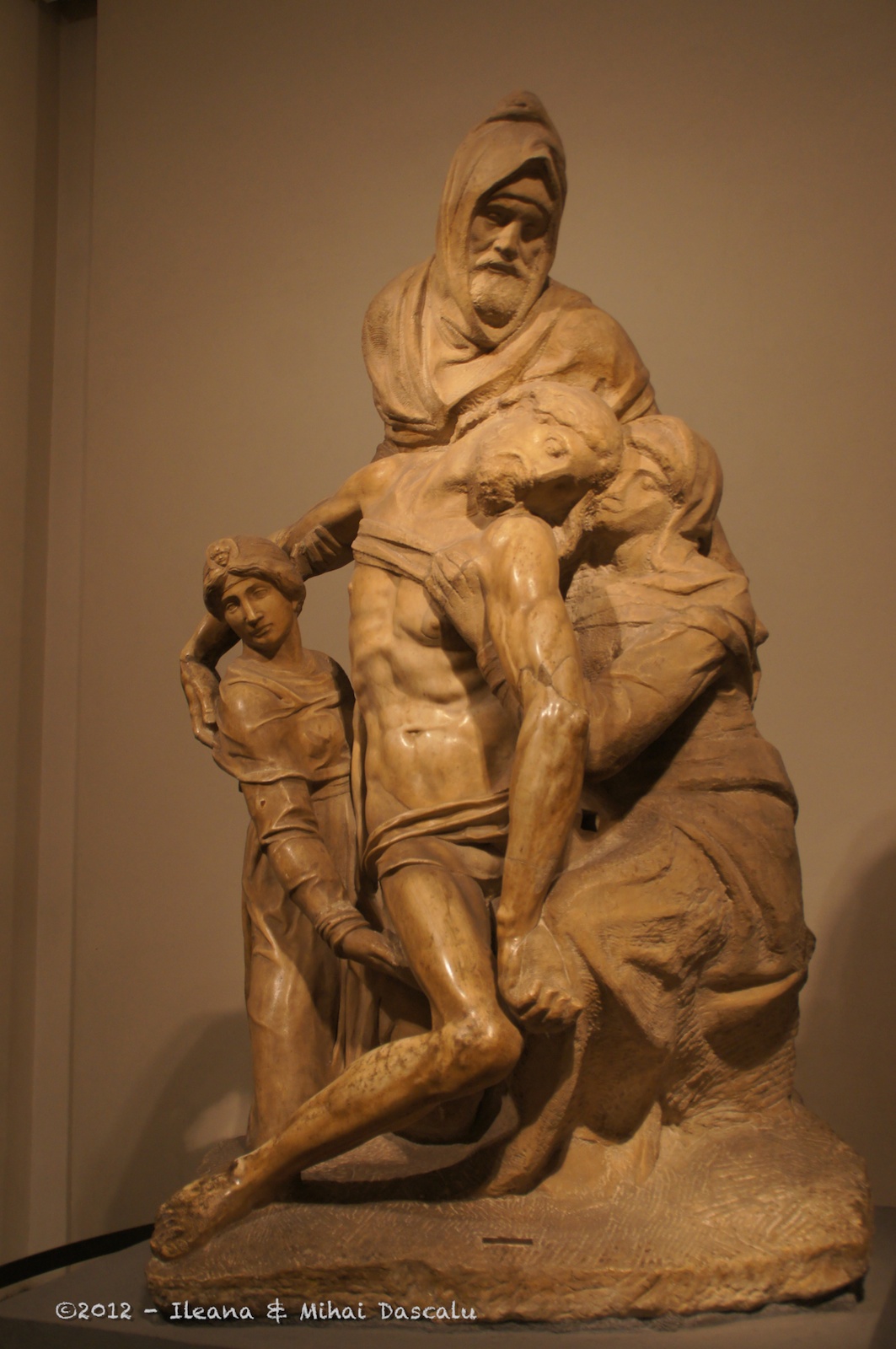
And there, in an alcove, is the Michelangelo’s “Pieta Rondini”. He never finished it, because the marble shattered and destroyed the Madonna’s elbow. It was a personal work, he intended it for his tomb, he gave his features to Nicodemus.


But it was not to be, his tomb in the Santa Croce Church is decorated with an allegory of arts. Death has a way of bringing people together; close to his tomb there are Dante, the father of modern Italian language, Galileo Galilei, the father of modern science, and Niccolo Machiavelli, founder of political ethics.

Michelangelo's portrait, above his tomb.
Why do people bother themselves to visit these places instead of looking at pictures in a book or on the internet? Because it is not the same thing. The light that enters through the windows, the walls that separate the world in outside and inside, the fact that we seem small and lost, cranking our necks to take in the details, the smell of frankincense, the sound of bells, all these converge. Visiting is committing ourselves, body and soul.

Vatican Museum has miles of galleries with art from antiquity to the modern times. All the nude male statues have become pudic, covered with stylized fig leaves. Many great works seem lost between others. “Madonna with child” is a frequent subject, and depending on the author, his times, his artistic abilities, I would pass quickly or stop to find out what entices me. There is a gallery with topographical maps of different regions of Italy, another with tapestries, and rooms after rooms painted al fresco.


The Athen's School by Rafael

"The Room of Miracles"  by Pinturicchio
The Sistine Chapel: the afternoon light makes the ceiling’s paintings look 3D, the surface separating our world from the ones in the paintings. There is a low hum as people sit on the wall-side benches and show each other St. Bartholomew’s skin, which has Michelangelo’s features, or the blackened spots, left as they were before the restoration. Unchecked, the hum becomes a clamor, determining the guards to utter “Silenzio, silence please!”

From here we enter St. Peter’s church and we are very careful not to lose ourselves (it is that big). The evening service already started, part of the church is closed for visiting, but it is illuminated, warming it up, transforming it from a touristic monument into expressed faith. An Indian woman, dressed in sari, kneels down to say her prayers. Two steps in front, her husband, hands gathered in prayer, follows the service. There is a different feeling here from the one close to the entrance, where Michelangelo’s Pieta is.


Our journey through Italy takes us to some other places.

Lost to nature, Pompeii and Herculaneum were rediscovered in the 18th century, under several feet of ash and pyroclastic material. This event triggered a search for ancient works and the Paestum ruins, left undisturbed thanks to malaria-bearing mosquitos, were put on the map.

Paestum

Herculaneum
It is eerie to be alone between those walls, in those gardens with pomegranates and rosemary bushes or with green pastures and sheep flavored breezes. In Herculaneum we see how the style of painting changed from frescoes that attracted you into their world, to walls painted in a geometrical style. The everyday objects, decorated domed ceilings, partitions for amphoras, mosaics, they all tell us about the normal people of that time, the ones that history has a habit of not mentioning.

Extra ripe pomegranate


Herculaneum

Ceiling in the public bath, Herculaneum
We have to thank Vesuvius for erupting and preserving tracks of wheels in the streets, prices for poultry, people’s shape and bones (the Romans cremated their dead), even papyri works.

Pompeii

 Pompeii
To see the real mosaics, frescoes and statues, we visit Napoli and its museum, both oscillating between careful exhibition and neglect. The city is dirty while its people parade slim, tanned, dressed in the latest fashion, with sunglasses even in the night time. They escape their small apartments (the entrance door opens in their living room) in the street where they talk, smoke (the whole Italy is a second-hand smoke hazard) and eat. Taking in consideration what we know about Mafia and following Marcello’s advice where to walk and at what hour, for the first time in a very long time we watch our backs every moment.


Venice is full of stairs and bridges, as Maria discovered. The Canal Grande, an inverted S-shape, unites the train station with the San Marco Piazza and numerous canals with each other, hence the bridges. Narrow streets, not too tall buildings, everywhere touristic shops and their customers. The Venetians invade the streets after 5pm, walking their children and dogs, talking with each other from a distance, oblivious to the hordes of tired tourists. The San Marco basilica, with its golden mosaics, wavy floor, its antique horse statues, pigeons, attracts numerous visitors every day. We also visit the Doge Palace in which we find a map where it is written “Romania”, where the Byzantine Empire used to be.


The Lion, the Doge Palace and San Marco Basilica


Why this title?

It is the title of a book written by Irving Stone about the life of Michelangelo. I’ve read it at least seven times, each time finding in it the inspiration and the power to follow my own dreams. Through its words I followed a world that still survives in its original place: Moses still decorates Pope Julius’ tomb, the allegories of Day and Night, Dawn and Dusk are still in the Medici chapel, Capela Sistina still stands, the paintings on walls and ceilings in the Palazzo Vecchio gallery count four hundred and more years, the buildings and bridges still have their original parts.

Moses- detail. The horns were supposed to be rays.


Ponte Vecchio, the Old Bridge, over Arno River in Florence
There is no fun to walk in cold rain, but it’s worth it if at the end I’m richer. What was just a name in the book Ghirlandaio, Giotto, Pinturicchio, now has substance, I’ve seen their works of art. Reading guide books helped me find The Genius of Victory in Palazzo Vecchio or Christ the Redeemer in Santa Maria sopra Minerva Church. I didn’t know about them, I was happy until I saw them, dusty, badly illuminated, too detached or not forceful enough.


His Prisoners in the Academia are still captives of the marble, but my mind follows the lines and I can see them, even if they’re blurry. To stand in the Campidoglio and fill balanced between the buildings, statues and stairs. The agony of having so little time, so much to see, to listen to too many Rick Steve’s audio-guides, to walk in circles, to skip meals only to have the ecstasy of seeing David’s eyes or the “life-giving touch”, to find something that I didn’t know about, a new Gauguin or Matisse,

Paul Gaugain—Mathew 5-8

Henri Matisse—Crucifix
to eat the original pizza, or baba, or sfogliatelli.

Pizzeria de Michele, with at least 2 hours of waiting in line to eat inside, or immediately,  outside. We pitched in with three boxes.

Sfogliattelli in the foreground, baba in the background
And in this flurry of searching and finding, there is one calm sunny, warm day in Toh-REE-no (Turin) when we meet for the first time with Ileana’s and my pen pals, Federica and Maria Rosa, daughter and mother. We walk the streets that come alive: this is the place where they sold and bought books at the beginning of the new school year,


 at this place they used to come for a cake and a song, here is Federica’s university.

Marco Didou— Echo
We share different kind of pizzas and focaccia di recco with a cheese called crescenza, seated on the concrete stumps. We learn to cross the street in the Italian style (half cross, stop in the middle, hold your hand in a stop sign and look intently into the driver’s eyes, and when he stopped and behind him are 3 more cars, continue to cross slowly). We help a blind old man find his corner to ask for alms. We pass and admire the camouflage of a McDonald “dressed” in brown and green, with classic style of woodwork.


I try to understand what makes Italy different, beside monuments and architecture. I seem to find my answer in a TV show called North vs South. The Northern Italy representative asked the Southern corespondent “Why do we have to be like you?” The answer came passionately, with the right hand fingers gathered, tapping against the chest:

“Ci siamo VIVO!”
We are ALIVE!

Mille grazie Italia! (ME-leh GRAH-tzyeh) A thousand thanks, Italy!
Ciao! Good bye!