The restaurant of the cruise is empty, besides Maria and myself—just the waiters changing the linens on the tables. Judging from their voices and gestures, they’re not too happy about a new batch of tourists, each with their whims and their steam blowing. I didn’t wake up on the wrong side of the bed—on the contrary, I was happy to escape the droning and the pervading fumes of the neighboring boat’s engine—just that I don’t feel inclined to find excuses: for the miserable western food (the juice, the milk are watered down, the desserts seem emptied from a can, and everything else is weird tasting—it’s not easy to follow a recipe if you don’t know what the result is supposed to look and taste!), for the forced jokes of the waiters trying to make us smile and have a “good time”, for the sky-high prices of everything not included in the service (a British woman tried in vain to convince the manager that 15 euros for a glass of juice is not a normal price!), for everything. I’m tired and the day has just started.
 |
| Market delivery |
When we embarked, we had to pass through three more boats to get to ours. Our rooms were on the main floor, large enough to accommodate, besides a king bed, two armchairs, a fridge, TV, and space for luggage. The bathroom had a large shower and everything looked plush and sparkly clean (in contrast with the public areas where it was a faded and thread-bare luxury). Like any cruise boat, it had an upper deck, where we could have a dip in a freezing pool, sun ourselves on deck chairs, serve tea, while listening to our fellow travelers, senior citizens from Britain, who wondered what should they wear at dinner time or were trying to keep up with their Jones's.
 |
| Aswan |
We chose to spend most of our time in the room, having a gorgeous view of the Nile. The lower course didn’t look like its former self: its banks were cladded in stones and steps, reminding me of the Indian ghats. I didn’t see many people, but maybe they were coming at a different hour. Parallel to the river was the road, traveled by donkey-pulled carts, bicycles, and, rarely, old cars.
Beyond that there were the fields—some light brown and freshly tilled, some green with crops. From time to time we passed some houses, some pastures with oxen, some wild areas. At one point we went into a lock, descending so rapidly, that we didn’t have time to go upstairs to observe the process before we were out.
 |
| The belly dancer and the Brits. |
 |
| A twirling dervish |
One of the advantages of this cruise was visiting some other temples. With this occasion we noticed that we had an Asian group with us, blocking the exit so they would be the first in line. Kom-ombo was special because we saw it in the moonlight with some accents from the spotlights. Actually, it is a double temple with two dedications: to Sobek, the god with a crocodile head, and to Isis, two holy places, with two tables. Close by was a museum where we learned more about the cult for Sobek and saw huge mummified crocodiles.
 |
| Swallowing the key of life. |
 |
| Being purified with celestial water. |
The other temple was Edfu, we saw it in the morning light. We left late (the Asians were up from 5 am to catch this one) and our only choice of transportation was Mr.Hamdi’s kalesh. He pointed out the English school, the Egyptian school, the pharmacy, the souq. He held a protecting arm around Ioan’s shoulders while going over the speed bumps. He asked our age: 45. He has 45 too, but he looked like 70, almost bald and a little white hair at the back of his head. His wife is 38 and they have six habibi (huh-bee-bee), I presume children. In the end he didn’t want to be paid, he wanted to wait for us. Mihai insisted. Mr.Hamdi asked 20 Egyptian pound per head. My husband just smiled, gave him 20 for all of us, and we left.

The Edfu temple is the most complete Ancient Egyptian temple. We found the same things, huge walls with bas-reliefs, some erased, Christian crosses, nilometer. And we found color, blue, and red, and black, and green hidden in the crevices of the hieroglyphs, or in between the column and the ceiling. They told of the wonderful feast for the pilgrim’s eyes, after days in the desert.
 |
| The boat that takes the soul on the other side; a copy. The original is somewhere hidden on the right side of the lower level stairs in the Louvre, Paris waiting for the reopening of the Egyptian gallery. |
There is another feast, for the initiated ones, the people who know how to read the hieroglyphs, the different types of crowns, the symbols that are sculpted in stone. They get to read the whole Gallery of Victory, to understand more than Horus fought Set, revenged his father Osiris, and since those times they celebrate annually this victory, eating a cake in the shape of a hippopotamus.
 |
| Having fun in the Gallery of Victory. |
 |
| And the victory goes to Horus! |
Mr. Hamdi waited for us, at his price: 20 liras for one person. We started walking, we had enough time to get to the boat. Immediately he agreed on our price, we climbed in, this time Mihai in front. They started chatting about soccer and Romanian players. Mr. Hamdi knew their names, we didn’t know any Egyptian soccer player. At the boat we payed him what we agreed and quickly he asked for a 5 lira baksheesh, for the horse. He got it!
Now that the cruise is done, we’re waiting for the hotel’s car to pick us up. Mr. Galal called us to tell that he can’t make it to Luxor, but he talked to the manager of the hotel to make sure everything is OK.
There is a long drive from the decking point to the city. It used to be closer, but with the new mayor, there are many changes, that have yet to prove their valor. The new hotel is better, the mattresses are foam, the bathroom door doesn’t close and the tub’s drain is clogged. But at least it’s clean and quiet...until prayer time. We notice the position of the minaret, the walls of the hotel acting as a reflection point.
 |
| Baked yams on the spot! |
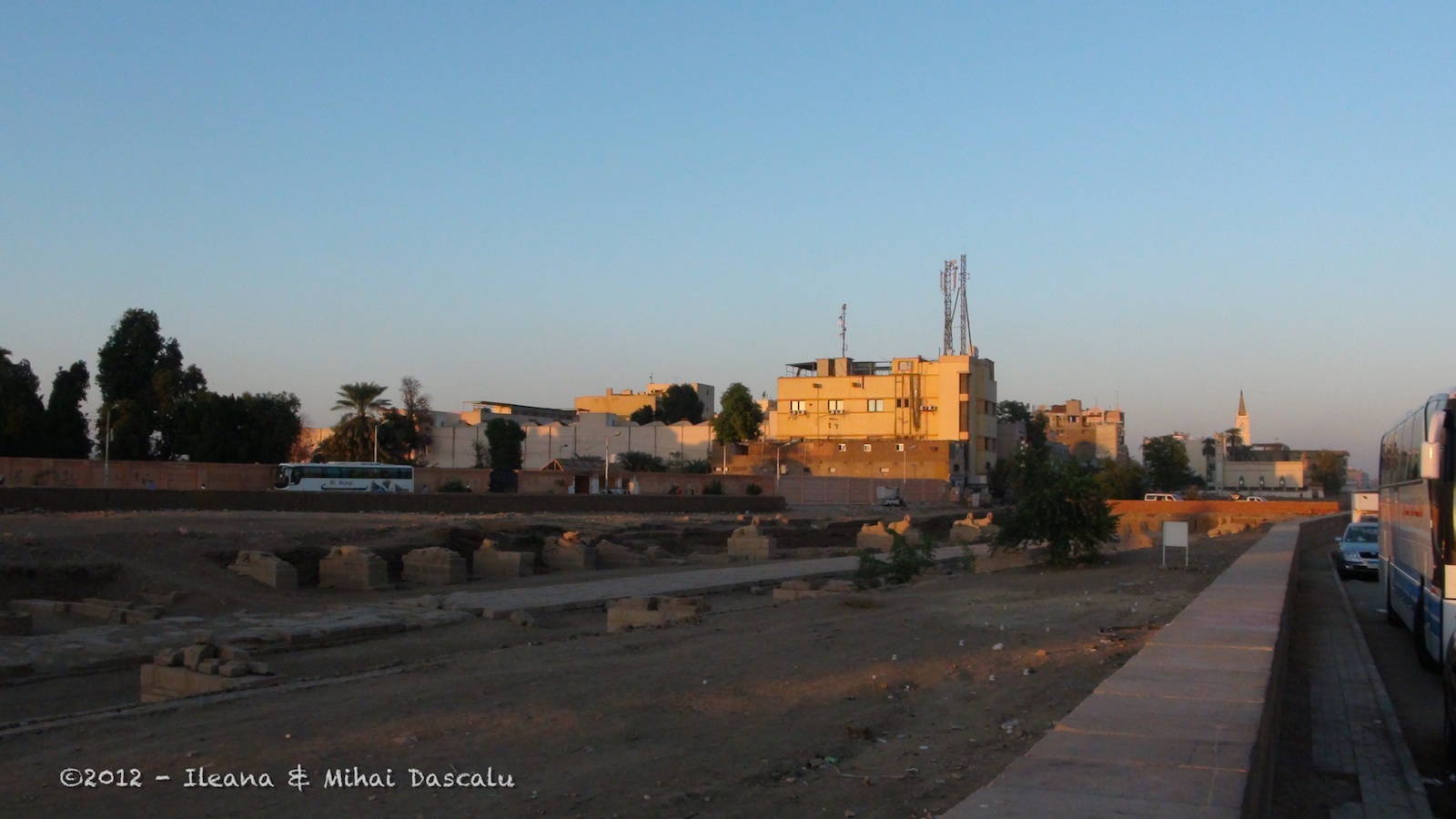
We start visiting Luxor, walking from the hotel to the museum. We make ripples, the taxi and kalesh drivers start moving when they see us. What we see is a huge trench, the riverside is being remodeled, they are digging for the sphynxes, make new streets. To escape a very insistent kalesh driver we enter a McDonalds and order a MacArabia, grilled chicken with salad and the sauces, but in a flat bread. We are told to wait at a table, and we do it, on the third floor, having a wonderful view of the Luxor temple. We decided not to visit this one, the general view was enough for us. An attraction could have been the oldest mosque, built inside its court, but it is closed for us non-believers.
 |
| Luxor temple and the mosque |
We want to see the museum, but we’re too late, the gates are locked.
 |
| A better kalesh |
The next day we go and visit the Valley of the Kings. We decide to take a guide, maybe this way we will understand better. Enter Nabil (Nuh-bill), dressed in worn-out corduroy pants, shirt and sunglasses hugging his face. The experience is a little bit frustrating: whatever he tells us we already know, and it feels general, or we don’t know and he doesn’t go into detail, we don’t have time.
The first being was Atum, meaning Perfect. He came into being before being and by thinking, he started to create gods and goddesses. It is said he married his shadow, gave birth to emptiness and moisture, who had children of their own, the sky and the earth. These last two had two sons, Osiris and Set, and two daughters, Isis and Nefthis. Osiris married his half sister Isis (“Why half sister?” the answer was just a meaningful look to stop interrupting). Set, jealous, killed Osiris, cut him in fourteen pieces which he threw in the papyrus. Isis (and her sister) collected them, and through magic revived him. Osiris, the final judge of the dead, holding the feather of truth and weighing it against the dead man’s heart, is represented in the tombs with a fusiform body and a green or black skin. Horus, his son, fought his uncle, avenged his father and lost his left eye in the process. That’s why he gave the ankh, the key of life, to the ones coming after him, to protect them from the evil eye (the bad thoughts of others).
Death is a journey, from this world to the other one, where they live forever. That’s why they need to take with them clothes, perfumes, furniture, everything and shabti, 365 of them. It means “answer” and their terra cotta or wooden painted presence is necessary to work in pharaoh’s place.
 |
| The tombs, hidden deep in the ground |
There is a strictly enforced policy of no photos. It is not enough to have the camera turned off, or in a bag, we have to deposit it. With the advanced technology available and the uncontrollable human being, they can’t take chances and have the surviving tombs degraded by the rays produces in the cameras. If, by chance, one manages to bring a camera and starts shooting pictures, one can find how easily they can confiscate it. So we walk downward in a tunnel painted with evil spirits being punished. Ioan is looking for cartouches with a goose and the sun (that’s the birth name of the pharaoh) or with a plant (the coronation name). Every inch on the walls is painted with verses from the religious books. In one chamber the ceiling is painted with a double image of Nut, the goddess of night, the one who swallows the sun each evening, to give birth to it every morning. On the granite sarcophagus there is a representation of the pharaoh being purified with celestial water, and another one holding in each hand an ankh.
There are many things that I would like to ask, but the rules prohibit the guides giving explanation inside. And when we get outside, we hurry to the next tomb, kind of the same, dug deep into the mountain, with three chambers, finished from the last to the entrance, but different pharaoh, different choice of verses, of artistic rendition. They were the fruit of the high priest’s mind, the one who designed the tomb, and the fruit of labor of many workers, organized in nine groups, who lived there. They were the ones who cut the rock, who covered it in limestone, who traced the design with honey, who painted it with colors mixed with egg white (to preserve it) and gold for the flesh of gods. Their tombs are also in the Valley of the Kings, made of mud-brick with just an inscription, no decoration for a mere human.
Only a few of the tombs are open, you never know which one because they rotate them. Some are unsafe and crumbling, others can’t deal with mobs of tourists. We’ve already seen graffiti from Roman and early Christian times, and again from Howard Carter’s times. He looked five years for Tutankhamen’s tomb, sifting through rubble, only to find it in the shadow of Rameses VI’s tomb. Now is always open, for a very expensive admission, but contains only the mummy, the other treasures are in the Cairo Museum. Still, the rotation doesn’t protect them from water infiltration and dark mold feeding itself on living breath and electrical light.
Hatshepsut’s temple: a modern-looking building in a vast desert, backed by the mountain, worthy of the woman she was. Daughter, wife and stepmother of pharaohs, she ruled Egypt for twenty-two years. To show her right to rule and power, she donned the full pharaoh’s regalia, with false pleated beard and all.
 |
| The Osiric position. |
Passionate traveler, she sailed to Punt seventeen times to bring back trees and vegetation, her trips etched in stone. Eventually she died, her stepson’s hate obliterating and erasing her name, her face, her deeds, her monuments, and through this, preserved some of them for our time.
 |
| A sample of the trees brought home. |
 |
| Loading the boat for the trip. |
We visit some nobles’ tombs, no granite for them, just limestone, easier to work with, flowing design, fluid movements, the wealthiness of hair-dresses or of weavings etched in the white material giving just a small sample of the variety in its entombed one’s times. The next pictures are from the Kha Em Het Temple.
 |
| They made mistakes too! The oval holes were made by the Roman soldiers sharpening their spears. |
 |
| The killing fields, conquering a new nation. |
 |
| Tied slaves |
 |
| Local attraction |
 |
| And another one |
We collapse at the hotel, tired, sun-beaten and hungry. We go to the neighboring KFC, we have no energy left for wondering what to choose or what we’re eating. Though there is food, we have to wait half an hour until they bring it: twelve freshly fried chicken drumsticks and fries, with freshly made coleslaw. We eat ravenously and return to the hotel.
We’re tired and worried. For the past few weeks I wrote home everyday, telling them that we’re still alive, no social unrest in our area. We don’t know if we should go to Cairo or not. The last night on the boat, the moment that they started showing the reprisals in Tajjik square they cut off the program. Was it because it was bed time? Coming home one night we saw people outside a building protesting. We look at each other: there is so much more to see, to do, to learn, to find, but there is no more fun, no more excitement. Twelve months in our trip we were still eager, two months later the thought of tomorrow, of the next monument, is too much. “Let’s buy the tickets and go home...”
 |
| Karnak temple for people who find it hard to imagine it in its totality |
With the end in sight we find renewed energy to finish Luxor. We go to the Karnak temple, constructed in periods, every respecting pharaoh adding his walls, her obelisk, his scarab, rows of sphinxes. It is humongous, too big to catch its layout in one view, too flat to see its relief, too straight to notice the lateral space. Our minds refuse the guided information, we don’t want anymore stories, just what we can register.
There is a hypostyle, a room open to the sky now, full of columns. Twelve open-bud ones line the main nave, while the other closed-bud hundred and twenty-two imitate the primeval papyrus marsh.
 |
| We're one man short and she volunteered! |
 |
| Namil |
In a different part we can make out faint painting of saints, from the times when these temples were transformed into churches. A guard is fishing in the sacred pond, for the ablutions of the priests, and feeds its cats. Russian tourists go seven times round the huge scarab in a counter-clock motion. We leave the main path towards other ruins, the ground covered in organized rows of temple shards. We know so much about the Egyptian civilization, and yet we don’t know enough.
We go to the museum of Luxor, where, again, the rule of no photos blocks us from sharing with you what we saw. We learn that the wavy lines under the pharaoh’s feet are the arches of his subdued enemies, that granite can shatter as glass at a mere few degrees of difference in temperature, that a few exquisite and diverse objects can bring much joy.
Again it is time to pack our backpacks, to verify if we took everything and shut the door behind us. This time we left intentionally a big pile of empty water bottles. The sterypen was useless, it is incapable of taking out the taste of chlorine and mold.
Giza, prepare! We come to see your pyramids!
 |
| I'm holding the smallest flowers that I've ever seen! |