Thursday, November 29, 2012

Some Egyptology

There are two kinds of people in the world. The ones fascinated about Egyptology and the ones who are not. I don't know where are we. We got tired of reading countless articles in National Geographics about Egypt, we have no desire of learning all about the thirty dynasties and all the names of the 332 or so pharaohs that we know about. But there is so much to imbibe from those three thousands years, and it is so simple to get the basics of it.

It all starts with the Nile. This is a river in Africa. The longest in the world. People spent a lot of time trying to figure out how long it is, they still don't know for sure. It crosses ten African countries, the last being Egypt.

There is a river in Africa called Nile

Monsoon rains in the mountains of Ethiopia brought seasonal flooding that would leave a thick layer of alluvial soil on the banks of the river. The high yield, further enhanced by a couple of groundbreaking inventions, like the hoe, and various irrigation methods, made the Egyptians the first group of people to practice agriculture on a large scale. They became rich in the process and a sophisticated culture and society was developed.

Everything was dependent on the annual flood. When the water was plenty, everybody was happy and nourished. When it was too much the floods would bring destruction and death. A bad year would bring hunger, but several dry years would bring famine and the collapse of the whole system, failure of the central authority and occupation by foreign powers.

They developed advanced technology to manage the water. The nilometers, deep stepped pits by the side of the river, would allow the measurement of the rising waters, predict the crop yields and determine the taxes that farmers would have to pay later. Canals where dug to move the water to extend the arable land and also to divert it to protect the cities and the temples from high floods. Saqia, an animal powered waterwheel, was invented to move greater amounts of water. During the dead times of the year, when there was no work in the fields, the pharaohs hired the farmers to work on various construction projects, just like President Obama's employment schemes during the most recent recession. So they built palaces and temples, pyramids and other sophisticated tombs.

The river has six cataracts, regions of low water and stones that make navigation difficult during most of the year, and sometimes impossible. They are counted backwards against the river flow and for our story the only one that is relevant is the last one, called the first cataract. This is the place that was usually the demarcation between the old Egypt and Nubia, with the famous city of Aswan, our first destination when we arrived from Sinai. A small city of about 300,000 people, it has been there for thousands of years, a border town and the quarry place for the best granite monuments in Egypt. The Egyptian obelisks that one can see in Luxor, Rome, Paris, London or New York are all made of stone from here. Aswan is also famous as the place that was used by the Greek geographer Eratosthenes to determine the circumference of the Earth in the third century BC. He got it surprisingly close to today's numbers!

This area has changed hands many times during the centuries. For most, the two nations had a peaceful collaboration, trading crops for gold, ivory and animals. At times the Nubians conquered parts of Egypt, other times the Egyptians took over. During the kingdom of Kush the Nubians installed their pharaoh in Egypt, starting the 25th dynasty. The whole region was sprinkled with countless temples and the interaction between the two cultures is there to be seen even to this day. In 1902 a dam was built by the British at Aswan and some of the temples were flooded. The dam was supposed to regulate the flow of the Nile and prevent some of the worst flooding. In a few years it was clear that it was not big enough and the dam was enlarged. It was still not enough and in the 50s the Egyptian government developed a project for a new dam. Despite international concern they went ahead with the construction creating the largest artificial lake in the world, lake Nasser. It was built with assistance from the Soviets, we learned about the High Dam of Aswan in elementary school, maybe laced with some propaganda about the strength of communism.
Sitting on the High Dam of Aswan
There were and there are strong concerns about the environmental impact of the dam, there is no silt passing through now, the waters are infected with bilharziasis, but the human impact has been tremendous. The modern Egypt could not have existed without it and maybe millions of lives have been saved by preventing the periodic devastating floods or famines.

What might not have been much factor in the decision to built the dam was the permanent disappearance under the waters of countless treasures of the ancient world. The international community started a race to save whatever they could, there is little mention, even here, of an active Egyptian involvement. It is a fascinating story to be learned in Aswan. The Nubian Museum tells it all and some information panels on the High Dam give some additional perspective. As many as 60 ancient temples were flooded. Eighteen of them were moved piece by piece to higher ground. The helping countries got rewarded with ancient artifacts and four countries received one full temple. We've seen the one at Metropolitan Museum in New York, but we've only learned and understood it's story now.

The biggest challenge and the highest achievement was the salvage of the temples of Abu Simbel. Built by Ramses II from 1274 BC, in a hill at the Southern border, the colossal Great Temple was dedicated to the deified pharaoh himself and to a couple of other gods. The four gigantic statues at the entrance were thought of as sentinels of the borders, meant to scare and impress whatever enemies: "rebellious subjects of mixed allegiance and the Kushite empire." We visited from Aswan, an interesting day trip. The wake up call was at 3 am. The hotel packed our meager breakfast, the same as usual, and we got in a 16 person minibus. We were among the lasts to board, there were a couple of other stops at nearby hotels and then we went to a meeting point where at least 50 big buses and minibuses were waiting for clearance from the military to get on the road. We knew we can only travel in a military convoy and I imagined a snail pace line through the desert. It wasn't like that. Once it started it was a race, the two way-two lane road was being used in one direction only and everybody was going as fast as possible. There are 280 km in the desert. After leaving the city behind there was no source of artificial light and the clear night sky filled with stars was absolutely magnificent. A little later we saw the sunrise in all its splendor.

Sunrise in the Sahara desert
There is a huge parking lot at arrival, the town of Abu Simbel is small, with some hotels and a little airport, almost everybody arrives at the parking lot, gets to the temples and back on the buses for the return journey. It is neat, well organized, and despite the fact that everybody comes about the same time it didn't seem crowded. The temple was built in a hill and when they moved it they built an artificial one, almost identical. You come in behind it, see the huge lake, and after a bend in the path the temples appear. The great one, on the left, and on the right, further behind, the temple built for the queen. They are impressive, but the first impression might be that they are not that big. Coming closer I realized that a 20 meter statue is quite humongous. They recreated it exactly as it was, a technical marvel, the colossi where carved directly in the mountain and they had to cut them in smaller, 1000 tones pieces to move them. I could hardly see any marks left. I was a little surprised. The second statue fell some three thousand years ago, the trunk is on the ground, why didn't they put it back together when they moved it? Strangely, whatever reason they had, it seems right the way it is. After taking a few pictures, we entered our first Egyptian temple. A huge hypostyle hall, a large vestibule, numerous side room and in the end the sanctuary. The walls have carved and painted stories of famous battles. We would see later the same design all over Egypt, and we learned a new word, hypostyle, made of two greek words and meaning "a roof resting on many pillars."
The Great Temple at Abu Simbel


A view from the side, the temple of Nefertari with the Great temple in the background

While crowded at first, the temple cleared a little later and when we returned after another half an hour we were the only ones there! We just visited the adjacent temple for Queen Nefertari, Ramses II favorite wife and we stopped for another tour. Pictures are not allowed inside, but since we were the only ones the guards let us take a couple from the entrance.
In the door of Abu Simbel Great Temple
It's absolutely stunning inside!

By 9.45 am we were back at the minibus, most of the other tourists already left. The road back to Aswan was empty, a lone band of asphalt cutting the Sahara dessert. Most of the time, it was just as we imagined it: a flat expanse of sand and nothingness. It was beautiful and, surprisingly, almost all the time we could experience the mirage. An endless surface of blue water shining in the sky, there was no doubt, that could only be some sea or a really big lake, with some little palm trees on the edge. And moments later, I would have to admit, over and over again, that there is no water, just golden sand. It was magical, but disconcerting and exhausting, I was glad to eventually see some dunes and hills and a little later the start of vegetation around Aswan.

The next day we took a trip around Aswan to visit another couple of temples: the famous one at Philae, and the less known one at Kalabsha. Both are much newer, from the Ptolemaic period (300 BC) and have been moved from the original locations. Philae is phenomenal, probably the main objective to see in Aswan.


Philae temple


The face of Isis was carved out to insert the Virgin Mary's face...


Kalabsha is out of the way, nobody goes there, we were the only visitors. The car took us on a back road, we passed some check point where they inquired about our nationality. We said Romanians and we were allowed to pass. The driver could not explain why it matters and if there are any tourists not allowed because of their nationality. A couple of minutes on the country road, by the lake, the driver found a boat, the only functioning one, that took us to the island and returned for us an hour later.
Interior court in Kalabsha


The monument to the Soviet-Egyptian Friendship viewed from the Kalabsha temple...

We left Aswan on a cruise ship, we stopped at two temples on our way. The boat departed a few hours late and arrived at Kom Ombo in the dark, around 6 pm. This is a unique site with a dual dedication to the local crocodile god Sobek and Horus the Elder. Dual dedication actually means that everything is duplicated and perfectly symmetrical, two hypostyle halls, two sanctuaries, two everything, except only one full moon! Wandering in the halls, between the columns flooded in light, looking at the carvings, we had time and we had fun. It was wonderful. In the end we stopped in the local crocodile museum, since they had a crocodile god they had mummies of several huge reptiles and a lot of related artifacts.
We're taking off on our Nile cruise

Details at Kom Ombo

Full moon at Kom Ombo

Next morning we visited the temple of Edfu. Built further away from the river and protected better from damaging floods, this is the best preserved temple of Ancient Egypt. Part of the fun was riding in a calésh through the city of Edfu.

Edfu in the morning

Behind the Edfu temple

By the time we reached Luxor, the former capital of Egypt and the place of the best touristic attractions we already knew quite a lot about the Ancient Egypt. We became somewhat familiar with their gods and their legends. I overheard an excited Egyptian guide explaining to a western couple that the story of Isis and Horus is surprisingly similar to the "legend" of Mary and Jesus and the immaculate conception. In any other place it might have been the outmost heresy, here it was just shocking. Interesting, probably the most enduring Egyptian invention was the hell. They invented it about 1600 BC, with all the horrible descriptions and details, the Greeks took it further with Cerberus and Hades and from them the Christians took it to new lows and used it for a couple thousand years. Now, I learn from the Economist that not even the Catholic Church believes in the hell as invented in the times of pharaohs, they describe it just as a place "removed from God." Oh, how many fascinating things come up during travel.

We are still ready for more.

Wednesday, November 28, 2012

My Egyptian Brother

Egypt is a strange country. There might have been an adjustment period after we spent almost three months in the "civilized" first world, but I don't think we noticed that. We were returning to something familiar, like Madagascar, Indonesia, India or Nepal. Yet it is different and somewhat weird. I am trying to grasp it and I cannot. The weirdest part is the interaction with people. And even more weird is that I found a little brother in Aswan that I didn't know I had and we all came to accept him after a while.


I met him in the street in front of the hotel that he manages. His English was good, he was pleasant, helpful and knowledgeable. He wanted to arrange our visitation schedule in Aswan. He recommended a restaurant for the first night, I shook my head, $10 per dish was too much for us. He walked with us to a little local restaurant where he made sure we got the locals price and we all ate for $12. Next morning he brought us falafel from home. It was great.


We talked about our schedule. What I wanted was not possible, too expensive, he wouldn't let me spend that kind of money. He got me the trip to Abu Simbel, at quarter of the price that others pay. He payed for a felucca ride on the Nile. He didn't let us go to the fallen obelisk, they charge too much for nothing. He got me a car for one day trip for $15. When I gave the driver a small tip he was very pleasantly surprised. He didn't let me buy Nestlé bottled water, is not good, is tainted, we needed to get the best water. And so on. His hotel had advertised internet, but of course there was nothing. He brought his hot spot from home, because my son had a game on his iTouch where he needed online access. He wanted to get me out of Aswan in two days, and without pushing offered us a cruise on the Nile for a "good price." And the price was really good, $100 per person for two nights, threedays, all meals and discount for my son. We took the next boat several days later. Meanwhile we had countless discussions about politics, religion, tourism, health issues, raising children in this world. He had four, he knew what I must be going through to raise my three. He was an "Islamist" by his description, deeply disappointed in the turn of the Egyptian revolution, the lack of economical and religious freedoms, the abuses of the Islamists that won the elections and the draft for the upcoming constitution.
Mr. Ghalal is sending us on a feluca ride


Botanical Gardens in Aswan


Felucas at Aswan


He put us on the cruise boat and he called a few times later to check if everything is OK. Once, my daughter answered and she handed me the phone: "It's your brother!"

I want to thank Mr. Ghalal, he was the most pleasant encounter and the most interesting puzzle that I had to figure out in Egypt. The few others were just annoying or entertaining short contacts. Here's a little.

We arrived in Aswan airport after sundown. Most of the 60 people on the plane had hotel contacts waiting for them. I never got a reply from our hotel, so we had to take one of the few taxis waiting outside. Not knowing where our hotel is and how far is the city, we didn't have much room for negotiating. It was a long ride, but the driver was nice and he pointed to us various landmarks of the city. We arrived at the worst hotel we've had so far. The title was held until now by a dump in New Jersey that we used on the first night. But this was worse. It could have been easily upgraded to a three star hotel, but the indifference in making it decent was obvious everywhere. When we entered, two guys were praying in the hallway, we waited respectfully for them to finish, still they got an annoyed attitude that stayed with them for another four days. They did not understand one English word, the manager was away, they would call him. We received a little apartment with two rooms, a rusted smelly fridge, a broken TV and leaky miserable bathroom. I am trying to forget how horrible it was, but my family didn't care that much and since it was already payed for we decided to stay. We even stayed one extra night, I refused to pay for it and it made sense to them, they wouldn't have taken my money anyway.


Breakfast at our hotel

Included breakfast

Thanksgiving meal, pita and yogurt

It was peaceful and quiet during the day and extremely loud almost all night long. After spending all the day hidden somewhere in some coffee shop, people would come out, drink tea and smoke sheeshas and sit in the garden of our hotel. They sat there almost all night, the music was loud, but not as bad as one Friday night when there was a wedding a couple of streets away. We stayed on the fourth floor but it seems that the concrete buildings surrounding us amplified the sounds even worse. There was some political turmoil in Egypt at the time, but even so I couldn't imagine what people had to talk about all the time. The alternative might have been to shut up and maybe, God forbid, work at something, but I am pretty sure that would be unconceivable to most Egyptians...
Yes, is not nice for me to say such thing, but the reality is that for thirty years there has been an official push to get as many Egyptians to have University studies. There was a law that guaranteed every graduate a government job, so there was a study that showed that a government worker in Egypt works for only six hours per week. That was before the revolution, when something was still getting done in this country.
Working in Egypt? The exception, he probably had to be physically present, most people are in the tea shops


People are nice here, they seem genuinely content to have visitors. Anywhere we walked past some person he would say: "Welcome to Dahab/Aswan/Luxor". Educated locals taught us not to pay any attention to vendors or touts, that being the efficient safe way of dealing with them. Most of the vendors we had to deal with were nice and they didn't rip us off. An exception was the postcard vendor. He had a price, too low to bargain about, but he also had stamps. He wanted to negotiate the price of those. We were buying in bulk. Most of the postcard stamps we sent to you from all over the world were $1. Here the vendor wanted 60 cents. I was content, how can you bargain on stamps, they have an official price on them. So we payed what he asked for, realizing only a few days later that the price printed on stamps was 40 cents. It blew my mind, but I learned that in Egypt all is negotiable. Even when buying a bottle of water in a store (!) or bread at the bakery, I bargained, made some money back and made them happy in the process. I negotiated hard a price for water in a store and decided to stick with that price and that guy for the next several days. We didn't even discuss money later, but when he didn't have change, the second time he saw me, he told me to come back and pay later and it was normal to leave without paying.

One day I passed by a barber. He invited me in the store, I asked how much, he smiled and invited me to sit down. I asked again, same response. Three times, four times. I smiled back and left the store. Another day, we took a cab and the driver didn't want to negotiate a price. He didn't even accept money at the end of the ride. He gave me his cell phone number and asked me to call him back so he could take me to my hotel. We left without paying, but I felt obliged to call him later and he got another trip. Egyptians.

Everybody knows a little English and tries to use it with us. In most touristic places they know a few other languages and I was surprised to see calèsh drivers conversant in Russian and German. By the way, they are famous for their scams, even though nobody can explain how they work. They yell out to you asking for 5 egyptian pounds for an hour ride, about 0.80 dollars. But reportedly they will ask for much more before you can get down. When we had to use one I offered a decent price and verified it five or ten times. They would agree and in the end ask for more. They wanted backsheesh. When I pointed that we already agreed on a price the first driver we used asked, logically, for backsheesh for the horse! To the second driver I knew the lesson and I offered the backsheesh for the horse at the end of the ride. He thanked me and asked nicely for some for himself as well, he, logically, cannot deserve less than the horse.


The cruise ship from Aswan to Luxor. It is the favorite mode of travel since the British started mass tourism in Egypt in the 1860s. Almost all the boats are rated five stars. On many of them the majority is made of "package tourists", Britons who payed it all from home and probably get a very good deal. They might not be, but they act like idiots, sometimes so convincingly that they are annoying. It seems like they land on the boat, without any knowledge or skills to deal with the locals. I heard one lady complaining that she got charged $100 for mineral water during a four day trip. She could have got the water from the vendors at various stops for one tenth of the price. They also drank beer and I saw an older lady giving in and giving away her open bottle to a 15 year old boy who was begging from the side. He ran away, hid in a ditch and gulped it all, looking all over to make sure that the policemen and the other boys were not seeing him. Compared to this the stupidity of the tourists buying souvenirs from the little boat that accosted us was almost entertaining.
The little boat gets a hold of the big boat

Merchandise is thrown to tourists who throw the money back...

On our five star cruise there was open buffet for all the meals. Our waiter rapidly diagnosed us, since we didn't want any drink we were not some of his typical fools. He left us alone and focused his attention on other tables. The food was abundant but bland almost horrible. Despite the effort put in by the cooks they just didn't have it. We enjoyed the involuntary show given by the package tourists who marveled at all the "goodies." The only good food was served for the last dinner, Egyptian food. Of course the tourists were disappointed and mostly refused to try or touch those dishes.
There was a free show, belly dancing, in the foyer. People took the best seats waiting for the performers. The audience was warmed up by a pitiful magician. There was one belly dancer and my words don't help me to describe how disgusting she was. But of course the tourists enjoyed the show and some of the older ladies even joined in. I left. It was scary. This artificial world of pretend comfort, luxury and fun is not for me.
Disgusting belly dancing

I got upstairs on the open deck, admired the full moon and wondered what my little Egyptian brother had in mind when he put me on this boat. I didn't have to think too long, the answer was clear all around me, the Nile is worth anything...
Sun setting behind the boat and 

full moon rising ahead of the boat


Monday, November 26, 2012

Aswan


“Wait there on the chairs!” says the security man from the airport. We sit for almost an hour, other tourists sharing the same fate. It is not because he has something else to do, he just talks with his colleagues, but I think this is a new policy (at least for me), they control things better in groups. We fly to Cairo to change the airplane (actually, it is the same one, with the same stewardesses, and almost the same passengers) so we could go to Aswan.

Again I have to face my fears, my own prejudices. This is a time of unrest, of social change, of political games. It is a Muslim country with 5-10% of Coptic Christians. Don’t we invite trouble just by being here? The number of tourists coming in is down, aren’t we a source to be ripped off? Are they really going to take us to the hotel or somewhere else? In whom to trust?

Outside the airport there are several taxi drivers, waiting for a client. Between them is Mr. Samir, who has in the middle of his forehead a crest, the consequence of many prayers (the Muslims pray by touching their forehead to the ground). That little voice in my head says “Him, you can trust him! No, no, no, no, I take it back. What if he is a fanatic?”


 But I don’t listen it anymore, Mr. Samir is talking politely with Mihai and he is inviting us in his seven seat car, a Peugeot from 1974. It is a long drive and from time to time he tells us that, somewhere in the darkness, we’re passing the High Dam, or the Philae Temple. We arrive at our hotel,
that looks more like an apartment building, on a busy and noisy street. They greet us in Egyptian Arabic and give us the keys, but if we want information we have to wait for the English speaker.

The image that appears when we open the door takes us aback: shabby and dirty. Half empty bottles of water and some flip-flops give me the feeling that we are in somebody’s else apartment. The bathroom has a wide river made by leaking faucets. The ventilation that blocks the only window and the light, doesn’t work. There are mosquitos and cockroaches (as I would discover in the night time). To plug the fridge would be electrical suicide and keeping food in it would invite a health hazard. The furniture is held in place by telephone wire, the wall to wall carpet is stained, the mattresses are lumpy. The only clean thing here is the bedding and the towels.

It is too late for this evening but we’re seriously considering to move the next day. And then we meet Mr. Galal, Mr. Mohamed Galal. He is the English speaker and the manager of the hotel. He has two boys and a girl and his wife teaches Arabic at the middle school. On his forehead there is a familiar sign. We will get to know him better in the days to come, but for now he takes us somewhere to eat and to be sure we get the Egyptian price.

Kofta, grounded beef with condiments, grilled, served on a bed of cilantro, with flat bread and tahini, hummus and salad.


He offers us a bottle of water, when we ask if the water is safe to drink. He will bring the internet from home (the one from the hotel is in a state of permanent repair) and falafel for breakfast, he will pay for a felucca ride in the sunset, he will bring fruits, he will transport us with his car where we’ll need it. In his words, he is Mihai’s younger brother from Egypt. This behavior raises all my antennas! I’m second guessing his every move though I have no reason. I will understand only after we will leave Aswan: Mr. Galal is an exponent of his culture.

We have to start slowly. Ioan is recuperating from a 24h viral stomach bug that affected his birthday. We try to make each one’s birthday special, to be somewhere, to do what they want and how they want. We celebrated his twelfth birthday in Lhasa, Tibet (it seems so long ago). Tsewang made a cake and we visited the most important Tibetan monastery. For this one he wanted to go snorkeling above the Blue Hole, one of the major attractions in the Sinai Peninsula and top five diving experience. In the morning he had a better idea, how about we stay “home” and have fun together? We enjoyed our breakfast, we talked, even played, and by the afternoon he already had a cold and fever.

Finally, enjoying his "cake"!


There are different opinions on what ‘slowly’ means. If you ask Ileana, she would tell you that she sleeps in, but Mihai, he schedules just one thing for that day: the Nubian Museum. There is one more decision to take: do we hail a taxi or walk? Given that is 15 minutes away, and we want to see the real life, we start walking.

The Nile river on our right...

The street on our left....

There is a men’s majority, dressed in their long coats, white or sandy-colored, wearing a loose turban or just a fez, sandals on their feet. They are waiting for a business opportunity in the shadow of a tree. The moment they see us, they start moving, looking furtively around, to see if they have competition. “Kalesh ride! Just five!” Kalesh is a horse buggy, but what is “just five” we have no idea. Is it just five minutes, five Egyptian liras, five dollars or euros? Anyway, Mr. Galal said not to take one, because some tourists had unpleasant experiences, “just five” turning out to be five something for every minute or step of the horse.


There are the felucca owners who want our business, forty liras for an hour, but for us, a special price, thirty liras. It is still double of the real price! At this point in our trip we are unfazed, if we want it, we barter, if not, we just walk away.

Women are present too, but they are passing by, on their way. Many of them follow the recommendation of covering one’s hair and body: from a loose shawl to niqab that cover the whole face (these ones are different from those seen in Saudi Arabia, they have a different cut and there is a linking above the bridge of the nose); from jeans with a short dress to a tight form fitting and colorful abaya, to a black covering  all.


The Nubian Museum turns to be an elusive one, we are walking for more than an hour in the raising temperature. But we are rewarded with the remains of a civilization. In its history Nubia fought with Egypt, the northern neighbor. Sometimes it won, sometimes it lost. Present time caught it as part of Egypt and its territory was covered by the lake Nasser’s waters. The sparse population was relocated, their artifacts salvaged and exhibited here: scratched or three colored pottery, jewelry, statues, even a whole silver horse harnessing (I don’t know what is the meaning of the blue sheep skin, but it can be seen on the dashboard of many cars).


The village life is represented through the everyday objects, colorful painted houses with glazed pottery embedded in the walls, siqua (the well from which water was extracted by oxen).

The Nubian women wear an abaya made from lace-like material.


The museum, which won an architectural prize for preserving the elements of the culture, has a garden in which petroglyphs, and houses, and Muslim tombs are exhibited.


Moslim tomb.

After a yoghurt and flat bread lunch, the parents leave for a felucca ride and the children remain in the hotel (it is Ileana’s turn to suffer from the stomach bug). We are riding in “Bob Marley”, a white, wide, flat bottomed boat, with a mast that holds the triangular sail. There is a small breeze, barely breathing, pushing us toward the middle of the river. The Nile is surprisingly clear, I can see the plants moving with the flow, and, it seems, drinkable (our sailor quenches his thirst with it). Somewhere we can hear voices singing “Alouette” and we track them to a couple of boys floating on a makeshift boat, pestering tourist with their French knowledge for some change. It takes quite a long time to sail toward the Elephantine Island, where the Botanical Garden is, and we enjoy the quiet ride (though we could hear the cars in the background and the motor boats, speeding people on the other side).


These oars are square! And heavy! And when not in use they hang next to the mast!

The next morning we wake up very early, just minutes after our noisy neighborhood tavernas closed their doors.

Chairs made of palm fronds, cushions, rugs, trees are the nocturnal decorum for heated conversations on secret subjects (at least for us)

A mini-bus picks us and drives to the place where a convoy is forming. Officials dressed in white shirts with black sweaters talk in walkie talkies, people are hurrying to their choice of transport, and we all start toward the exit. The two line road is just one way at this hour, toward Abu Simbel. There is an incredible sky, almost black, with so many stars, it seems unnatural. Though it is the Northern Hemisphere, the one in which I grew up, the one that I missed while looking at the Southern Cross, I recognize only Orion. After a while, one side becomes bluish, then milky, then pink, then out it rolls the fiery sun.


In Abu Simbel are two of the few fortunate temples that escaped drowning in lake Nasser. For thousands of years they’ve met the gaze of travelers, telling about the greatness of Egypt. People are still impressed by the size and architectural design, even if it was cut up in huge blocks, numbered and lettered, and rearranged on a man-made mountain. They were saved by the international efforts of UNICEF and science people from many countries, along with other temples, for each a different problem and a different solution.

Picture of a picture of their original position

Where they were, the water line and their new position


For now the sun rays color the stone with an orange hue. There are people everywhere, guides talking to their groups. We make our way toward Ramesses II temple, a first line of owl and falcon statues guarding the four seated statues of the pharaoh. One is broken by a natural occurrence, its torso and head lying at its own feet. A small entrance, with Nubians and Syrians slaves in bas-relief, leads us to the inside of the temple and the story of a culture.


The story of the universe, of its gods and goddesses, of this pharaoh and his accomplishments, written with hieroglyphs and painted on every surface in three rooms, each one smaller than the previous. Two times a year a ray of light illuminates the innermost sanctuary and the statues of Amun, Ra-Horakhti and himself (the fourth one, representing Ptah, the god of the Underworld, is for always in the dark).


Nefertari’s temple is built in a similar manner, only it is smaller. She was the beloved wife and his love declaration is for everybody to see: her statue is the same size as his! Back in those times the wife was represented as tall as his knee. We take pictures of the outside, we visit the rooms, take it all in. It doesn’t look like this morning, because of the high sun, the stone is a whitish yellow and the statues almost lost their features. We return “home” tired but happy.


Our last day in Aswan we spend it visiting some of the other highlights:

To reach the next one we have to pass by men selling jewelry, pick a boat, haggle for a lower price, climb into it, hope it doesn’t die in the middle of the lake and enjoy the ride toward the island.


The Philae Temple, dedicated to Isis, reveals itself, its walled courts, the perfect contoured scars left by the Christians after erasing the portraits of the gods.

This pharaoh holds from the tufts of their hairs his new slaves


 We can’t help but overhear the stories told by the guides: how Osiris was killed and Isis, his wife, gathered his cut up body, mummified it, gave life to it again and gave birth to Horus, the one who will avenge his father, by fighting and killing Set, the bad god. Here it is Horus, represented as a child, stark naked and suckling. The Christians carved out Isis face and put instead one of Virgin Mary.


And, the Egyptians were the first ones to use the flowers as a symbol of love! Yeah, if you consider that Ancient Egyptian culture has extensive remains, and older cultures have just a few, truly the first ones to use flowers as the symbol of love were the Egyptians.

I presume the one with the wings is Isis, protecting Osiris, I don't know who is the one with the offerings, and in between them papiri flowers!


We also visit the High Dam, the one responsible for a better life in the last decades in Egypt. It has this name to be differentiate it from the Lower Dam built by the British at the beginning of the 20th century. In a way it is disappointing, there is a large amount of water on one side, a tiered hill ending in the Nile on the other side of the four lane highway. An informative panel gives us a clue about the layout, how deep, how long, how much, but no opportunity to visit the turbines, no ecological concern for the silt that can't reach anymore the lower course of the river. Just the faded politics of yesteryears and the Russian input of money and labor, framed in a Friendship Monument.

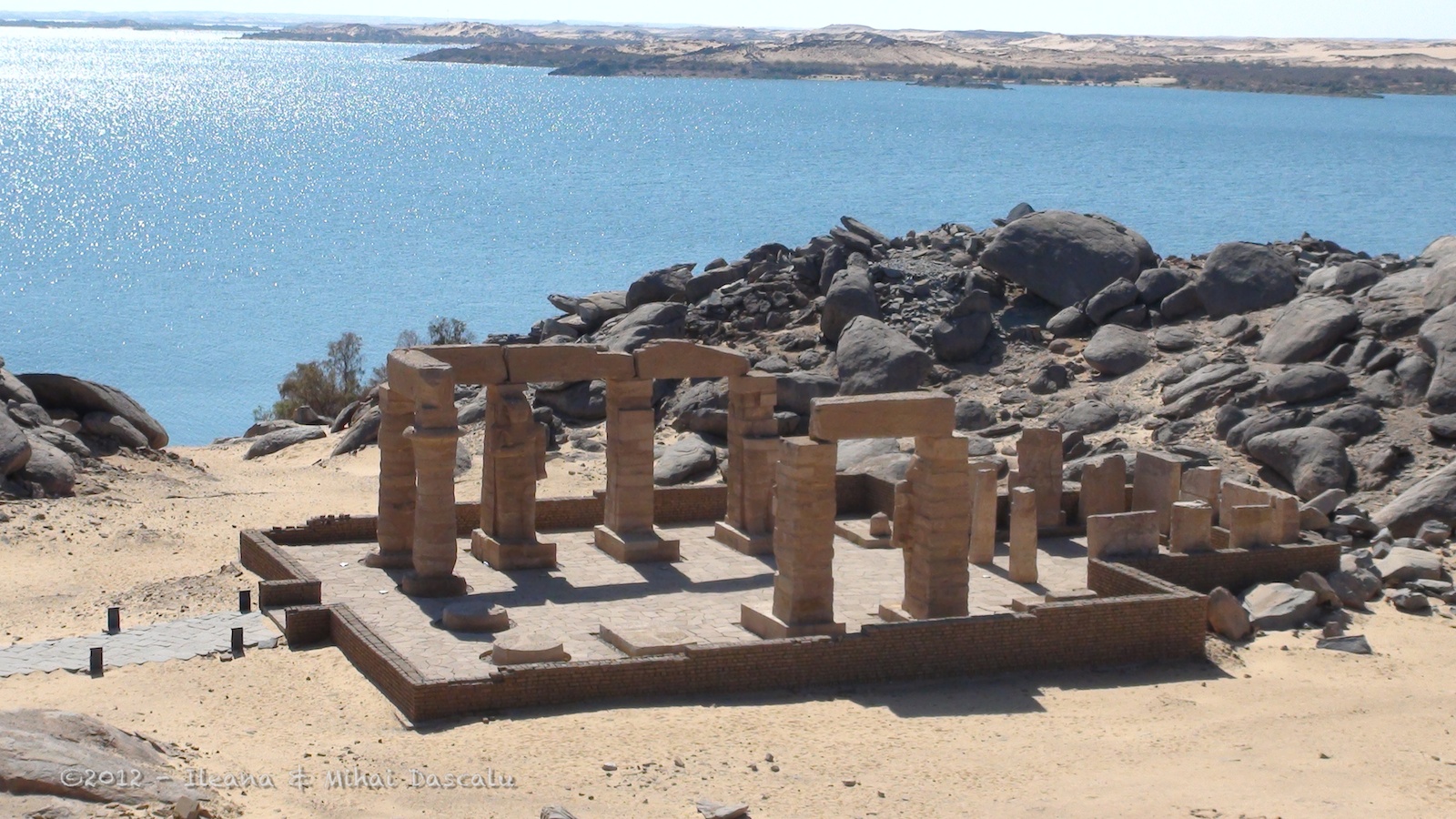
Close by, on a man made island, there are other temples. Kalabsha is almost complete, its missing roof replaced by linked wire, to keep out the pigeons. They don’t seem to understand and work hard for their nests. The guardians survey our little group and send forth one of them to open the doors for us. He shows us the Nilometer, a device invented for calculating taxes. There are different ones along the Nile, but the principle is the same: a rounded well with stairs, connected with the river. When it flooded, the water level raised, would mark a notch, making possible to predict the amount of crops, and through extension, to establish the taxes for that year.


I don’t remember the names of the other ones, but they were small, just a few columns, or sculptures. I liked the delicate paint.


Finally, we’re leaving Aswan. Mr. Galal picks us up from the hotel and drives us to the one floating on the Nile river. He takes care of us, talking with the manager, verifies that we have everything in our rooms. Then he gives us a pep talk, not to believe strangers, to be careful what we eat, to look if things are the way they are presented. He keeps touching the lower eyelid, his mouth, his chest with his index finger, I’m wondering if he has a problem, but no, its his way of underlining the importance of watching our surroundings. He wants to come to Luxor, he can make it as a business trip, to be sure that we are OK at the next hotel. Mihai is afraid that we will have a physical 6th person and he doesn’t know how to talk him out of this trip. Eventually, we say good bye.

Maa salaam Mr.Galal!


We’re ready for our next adventure: cruise on the Nile!