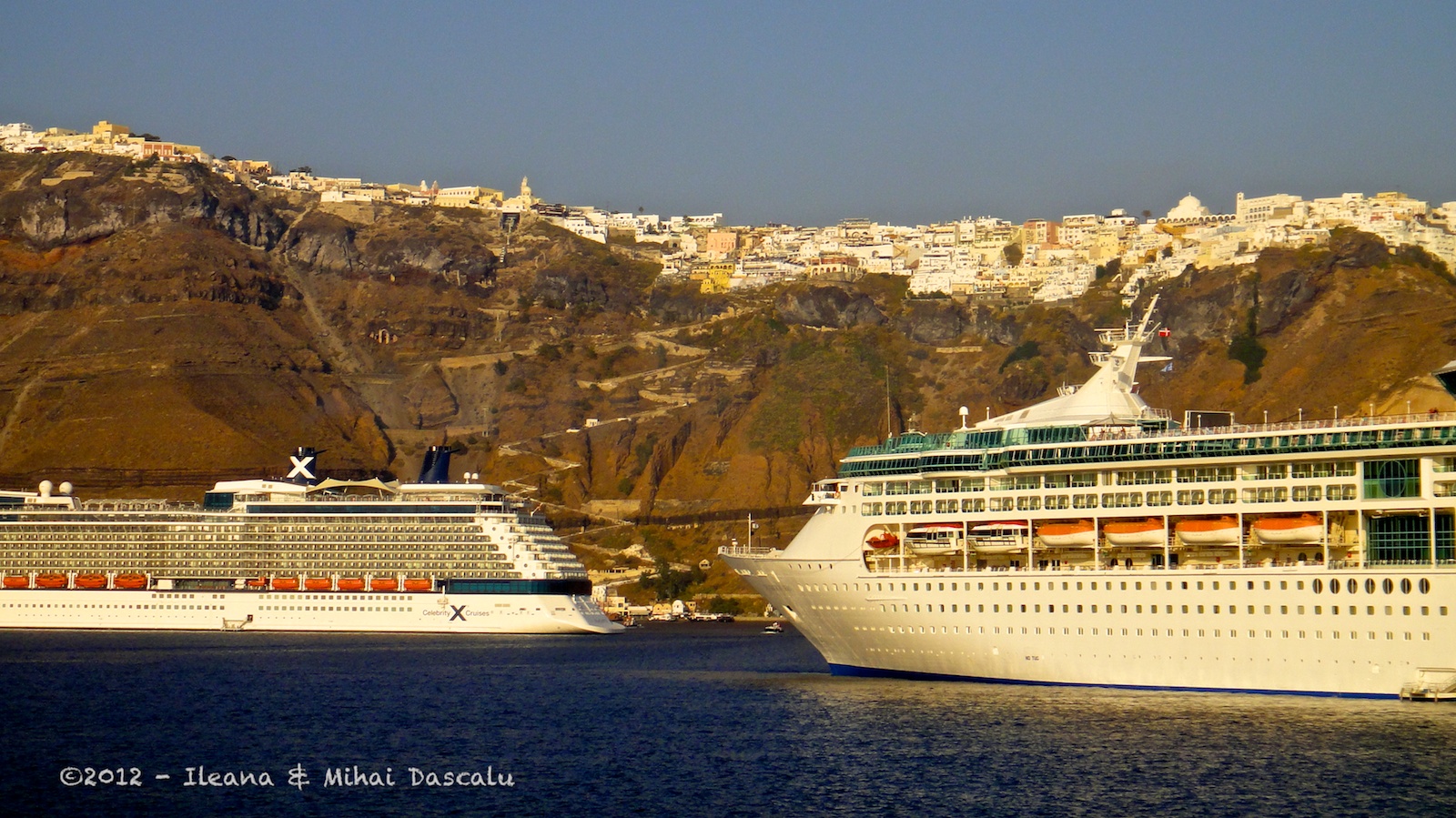
I never understood how Eol was such an important god, actually I didn't understand why he was a god at all. That is until now, when we left the island of Mykonos on a BlueStar Ferry. It is the biggest boat we've ever been on, but the wind is so strong that everything is trembling. Anna, the owner of our hotel, repeatedly told us over the last week that we are lucky, they didn't have one good day all summer. We had two or three days without wind, it was uncomfortably hot, but, when the wind blows, it is almost cold and it is certainly unpleasant.
 |
| Sunset in Mykonos |
 |
| Little Venice (so they say...) |
 |
| Street in Mykonos |
 |
| House in Mykonos |
 |
| Visiting the grandparents at their hotel |
We came to Mykonos to meet with my parents. It was decided 6 months ago, my father had a conference and the major event was my mother's special birthday. It was also a defining mark on our trip. All the broad strokes and sometimes even the daily details have been set up until September 30 - we left the last ten weeks up in the air, not to think or plan anything about it. Ten weeks sounds like a lot, but it is a painfully short period of time. Every now and then we had a short conversation about the subject, just listing some options but making no decision. It was in
Prague, on September 8-9, that I finally found a good way to put the question. By any account, we had a good trip, we were lucky, we saw a lot of amazing places, what do we still want to make this journey complete?
I had individual discussions with the children, we spoke out loud and I decided that Italy and Egypt would have to make our list. There are so many countries in the world, so many appealing destinations, but on a trip like ours, focused on learning history and culture, these two cannot be missed.
It was decided. Then, the next question was how to get to Egypt. From Europe, the cheapest option is to take EasyJet to one of the touristic resorts on the Red sea. Either Hurghada or Sharm-el-Sheikh. The first is on the continent, relatively close to Luxor, the second is in Sinai, with easy access to St. Catherine Monastery and even Petra. The departure can be from London or from Geneva. I found a cheap flight on November 13 from Geneva. That left us with 6 weeks from September 30. We voted to spend three extra weeks in Greece and three in Italy. Then we would fly from Rome to Geneva and go to Egypt from there. We would get a little taste of Switzerland and meet another family friend that we haven't seen in ages.
 |
| Schematic representation of our Greek segment |
This is how we came to make our schedule for Greece. After the first week spent in Mykonos what will we do? We wanted to visit Crete, Rhodes, Santorini. We wanted to go to the Peloponnese and maybe back to Athens. We have very good friends there, Cristina and Dan, and we wanted to meet with them. I was shocked to see the high prices for ferries and that made our schedule. We cut off Rhodes. To get to Santorini we took a slow, cheap ferry to the island of Syros. After one night there, another slow ferry would take us further.
So what's in Syros? Nothing really, except the most fantastic Greek city anyone can imagine. Ermoulaki, where we spent our only night, is centered around the little port, has a great neoclassic agora and little streets of marble that go up the hill. It is beautiful. We saw it Sunday in the afternoon when it was quiet and we were alone, we saw it at night and next morning when it was busy and crowded. We loved the full moon over the bay, the gyros at a local restaurant and the baklavas bought for dessert from a specialized store. It saved us money to make this deviation, isn't it the perfect combination?
 |
| Neoclassical square in Ermoulaki |
 |
| Marble streets |
 |
| The port in Ermoulaki with the full moon |
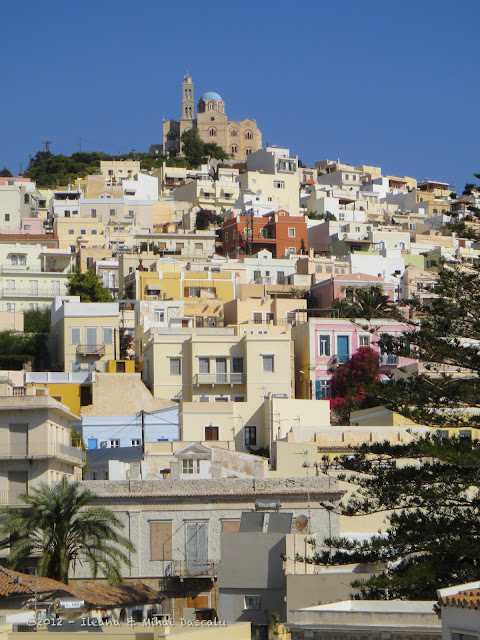 |
| Ermoulaki |
Santorini doesn't exist. The name is used for tourists, a mispronunciation of what Venetians called Saint Irene. The real name is Thyra. A small but fantastic destination, the island is what's left of the cone of a volcano that exploded in 1700 BC. The western side is rough and abrupt, the side of the caldera that is now submerged. The eastern side, with some mild slopes and beaches was left for next time. The capital of the island and the main destination is the city of Fyra. The iconic images of Santorini are taken 20 kilometers away, in the small village of Oia (pronounced EE-ah). Almost completely destroyed by an earthquake in 1956, the village was rebuilt to make it even more picturesque and attractive than it was before. It is crowded and very touristic, but even so it is the place to go at sunset and is enjoyable nonetheless. It wasn't a good sunset, but we were glad we made it. We took a taxi to get there and came back on a very busy bus. The girls, squished in the aisle between the chairs, started some conversation about our RTW trip with some Indian couple from Australia. As they were pushed back by the crowd, they continued the conversation with the people sitting in the next rows, while their mom was left to answer more questions from the Indian gentleman. An amazing rolling conversation, maybe there were 20 people listening and progressively getting involved. I was happy when the bus got stuck in traffic and they let us get off.
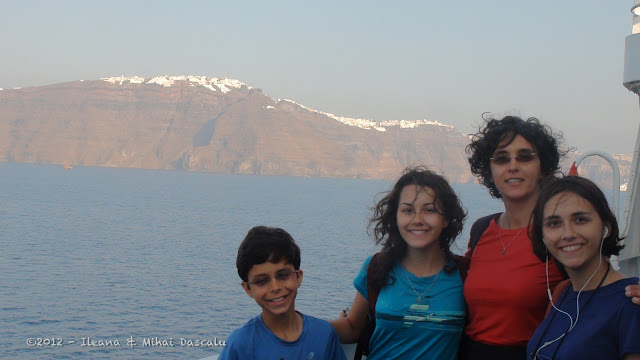 |
| Approaching Santorini |
 |
| We thought we had a chance to catch a beautiful sunset... |
 |
| Oia after sunset |
Next morning we visited the center of Fyra, the archeological museum, the Orthodox Cathedral and the promenade full of tourists and stores. I bought some local wine and pistachio. It never rains here, it is the driest place in Europe, but there is a mist in the morning air that waters the plants and makes them have a special, unique taste. It's great! By 4 pm we were in the port waiting for our connection to Crete.
 |
| View from below and |
 |
| View from the top |
We only had six nights in Crete. Next time we must stay longer. The largest Greek island and the second in the Mediterranean after Cyprus, it is a world in itself. The geography is defined by the high mountains in the center with valleys and gorges leading to small isolated beaches. The island has a very long history, starting with the Minoans 3500 - 4000 years ago and being occupied by (almost) everybody, even Egypt in 1840! It only united with Greece in 1905, recognized as such by the rest of Europe only in 1913. Tortuous roads, old people, beautiful vistas, good touristic resorts, some amazing beaches and a unique culture make it a very attractive destination. We had a little rented Peugeot with only basic functions, not even a radio. The one time I had to put gas, an old haggard little lady filled our tank, that was an awkward but almost mystical experience of blending the modern and the old of this land.
 |
| This is a poster from a bus station, I am not the only one who came up with this metaphor for Greece |
The first couple of nights we spent in Heraklion, the capital, we had to visit the Knossos palace and the city itself. After the palace and the archeological museum, Ileana took the kids and returned to the hotel. I kept going, visiting the rest of the attractions, the museum of Crete, the thousand year old Orthodox church, the Venetian fortress and the touristic center.
 |
| Almost 400 years old, the Morozini Fountain in the center of Heraklion |
 |
| Venetian fortress in Heraklion |
Next morning, we picked up our car and hit the road. We stopped on the northern coast, in Rethymno and Chania (Hania), smaller towns with Venetian fortresses, lots of history, picturesque ports and little streets. And an American movie crew that was blocking streets, forbidding traffic and making everybody nervous. That was in Chania, in the old port, we even saw some Hollywood star walking away angry after a verbal fight with the director.
 |
| Hania |
 |
| Street in Hania |
Before the end of the day, we turned south toward the mountains. We were going to the Samaria Gorge. Yes. We got this too, another attraction, another most something, another must. We were not disappointed, we again tested our limits and somehow got through. It is considered the longest gorge in Europe, like going all the way from the top of the Grand Canyon to the base, just at a smaller scale. The park starts at the top of the mountain and winds down for 16 kilometers to sea level. The width of the gorge varies between 150 and 3 meters with vertical walls that soar up to 500 meters. At the end of the park a simple cafeteria serves the best ice-cream in the world. From there, after another 3 kilometers on the road you step in the Libyan Sea. The start and finish points and everything in between make for a great overall experience. There are no roads to connect to the rest of the island. There are many gulfs on the Southern coast of Crete and the way to get from one to another is by hopping on a ferry, going left or right. The Samaria Gorge ends at Agia Roumeli, a tiny village with a couple of restaurants and a black pebble beach. A refreshing bath comes free for the exhausted hikers. We took our ferry and got to Soukia. From there we took a bus for an hour to the meeting point where the hotel owner was going to retrieve us. It was getting dark and we were climbing on the tortuous road. The driver has done that several times a day for thirty years. But among the travelers there was a restless twenty something French girl who had questions. She moved next to the driver, they started to talk and I sensed trouble. His ego swollen by her attention, he showed her every trick he knew. Please, if you're an attractive young lady out there and you value life (yours or others) - never talk with a 50 year-old Greek driver.
 |
| Entrance to the Samaria Gorge |
 |
| Everybody is ready to go |
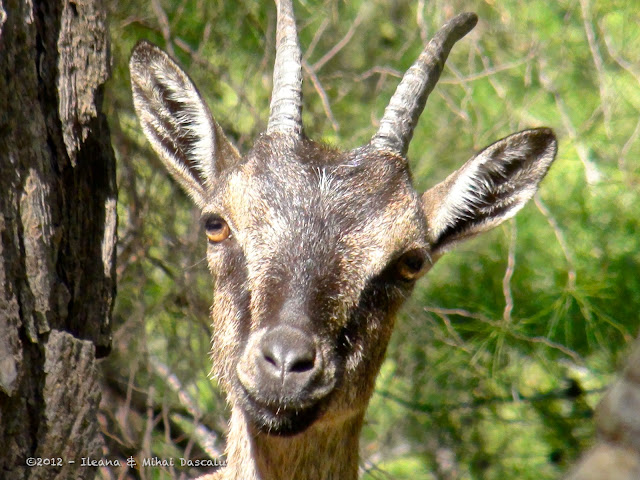 |
| KriKri, the protected, endangered goat from the park |
 |
| Samaria Gorge, close to the finish |
 |
| Leaving Agia Roumeli |
We spent two nights in the mountains at Omalos and had the chance to see a little bit of the traditional Cretan way of life. The hotel owner had a thousand sheep that he and his father were milking twice daily, by hand. He showed us the bunker where the cheese-wheels were aging on countless leveled rows. His mother and his wife were covering the kitchen and the hotel maintenance. The rest of Europe thinks that Greeks are lazy and they spend all their life playing backgammon or cards and drinking coffee or ouzo...
 |
| The road to Omalos |
 |
| Exari Hotel in Omalos |
The fifth night was open. We had a general idea of direction, we wanted to see more of the Southern coast of Crete, but we had nothing arranged. It could have never worked better. After crossing one hundred mountains and valleys, on various twisting roads, we stopped in Plakias. A large beach at the end of a gorge, apparently Eol is going crazy all summer so the village is underdeveloped. For such a fantastic place, there is a moderate number of hotels and not too many tourists. We badly needed to use the bathroom, we stopped by a cafeteria. Aren't we lucky! The hotel above them didn't have any room for that night so we kept looking and we found a fantastic apartment, with a nice pool, across the street from the beach. They took us in. I could have stayed a whole month, but we had a plane to catch. We asked to stay a little longer and they let us until 4 for free. Since we arrived early, we had two days to go to the beach, rest and refresh. For me, Plakias will certainly make a top 10 list for this trip. Then we went back to Heraklion and next morning we took a short flight to Athens. We had no schedule and two weeks until our next flight to Italy.
 |
| Plakias, view from the top |
 |
| The beach at Plakias |
Cristina and Ileana have been best friends for 35 years. Dan and I got in the picture more than twenty years ago. We last met in 2006 during our short stop in Athens, it's been a very long time. Phones and emails can only cover so much, we were really excited to see them again. They live in a small apartment, somehow they squeezed us in and it was great to spend as much time as we could together. It was the first time I met their daughters and our children connected easily. Their youngest one, age 16, took out our girls to experience the night life. I was told to relax, this is Athens, nothing bad can happen. I never found out how it was, nobody asked for my permission or my opinion...
They took us out to dinner for a traditional Greek meal, one of the best meals I ever had. I loved kokoritzi, it is something made of sheep intestines and it is delicious.
There are many amazing things about our friends, but the most surprising was to have them ask a million questions about our trip. It is the fate of all long term travelers that people ask a couple of polite questions, they ask which place someone liked most and move on to their mundane daily subjects. We expect that and we understand it. Here it was different, we spent many hours talking with them about every aspect of our trip, it was a joy for us to be able to share, but it also caught us not prepared enough. We shared stories, movies and pictures and they still wanted more...
Athens is a huge sprawling city of four million, but sometimes there is not enough room for everybody. Angela Merkel, a German prime minister, decided to come here the day after our arrival. The city was preparing for dramatic demonstrations, strikes and blocked traffic. The subway was stopped, buses were not running, the government banned any manifestation in the center of the city, which of course made people angry and more determined to come out. We didn't wait for that. After hours of discussions with Dan we made our plan. They gave us their car and we took off on a few busy days all over Greece.
 |
| Rocks at Metheora |
 |
| Olympia Stadium |
 |
| Amphitheater at Delphi |
First we went all the way to Meteora, 300 km North of Athens, safe and quiet. From there we came back South toward Delphi, then we went West to Olympia and finally arrived on Friday evening in Ermioni. This is a small village in the Peloponnese, 200 kilometers from Athens, our friends have a little house there and they waited for us to spend the weekend together. Then they went back to work in Athens and left us in their house for "however long you want." With their car!
We stayed almost a week. Most of the time inside or on the porch, the children worked hard at their school subjects. Ileana and I tried to put some order in our blogs and pictures. Sometime in the afternoon we got in the car for a short ride to some beach. We ate pomegranates from their tree ten times per day. And yogurt and olives and grapes.
 |
| Two of the beaches around Ermioni |
 |
| On the porch |
 |
| Solving math problems |
 |
| The little port of Ermioni |
Again and again, time flies too fast. We had to leave, and the day we returned to Athens was really busy. We stopped in Epidavros, Nafplio and Mycenae and only made it late at night, after an impossible schedule. For what we did in all these places read the following post
"A History of Greece through Our Travels".

The last two days were left for Athens. It is not enough to get to know the city, but we did cover the major ones. We visited the Acropolis and the new Acropolis Museum, and I took a few more hours by myself to reach some places that interested me. Sunday, my wife "abandoned" us, she took off by herself to another island, I took the kids to the Ancient Agora and the National Archeological Museum and we were done. Almost. I invited them to see the Sintagma Square, the historical place of Athens, the site of the Parliament and all the violent demonstrations of the recent or more distant past. They didn't want to go being cautious and tired and hungry. Walking toward the subway and talking about the pros and cons we arrived at a place with guards in historical costumes and pigeons. I gave up, "let's get home." By the way, "you spent the last five minutes in Sintagma Square, that's the Parliament and that's the place where the protests usually take place." It was a quiet Sunday afternoon, as I expected Greeks are too smart to waste their weekends with public manifestations.
 |
| It's peace and quiet at the Parliament on Sunday |
The Greeks have their quirks and most annoying of all is the passion for defacing and destroying road signs. In some parts, like in Crete, they shoot bullets in the signs, most other places they paint over it or put stickers over the meaningful information. Driving can be fun at times, for hundreds of kilometers I was going 40 km over the speed limit, but I was the slowest one. The roads alternated between nice modern highways to country roads with varying width, anywhere between one or five lanes (total) within a couple hundred meters. Not that any lane lines were ever painted. It's just a little example but for me a powerful metaphor for life in this country. There is a sense of wilderness and freedom lost in most other developed countries where rules, regulations and threats of fines and jail keep people in check. We all accept that corset as the price we have to pay for civilization, assuming the others are so bad that we have to tell them what to do. But in the country that invented civilization that is never in question, they seem to leave people live their lives. Somebody would argue that because they are like that they now have all the economic problems. It's not that.
Greece was over. We really really loved it and it was fairly hard to get going again, another destination, another flight, another country. There is some excitement when that happens, much less this time. Cristina waived behind the airport bus and after we lost her sight we watched each other and smiled.
 |
| Bye bye and thank you! |